Thursday, 30 April 2020

The Humble Panier


The ex-GRW 0-6-0 panier tanks were easily recognisable and found all over the Western Region of BR. We rather overlooked them, with so many named classes operating in the same area and vying more successfully for our attention. There were various numbered sequences of this type of engine, representing both Collett designs from 1929 onwards and Hawksworth versions, which were still being built in 1949, after the GWR had become part of BR.

John Dyer photographed members of the class at various locations across the network, including at Croes Newydd sheds at Wrexham, where I also remember seeing them towards the end of WR steam on 31/12/65. They had previously worked the Brymbo and Minera branch line in the hills around Wrexham and occasionally we saw them there when we were exploring North Wales from home by car. The last example I saw working was hurrying through Chester, light engine, during the following year. Croes Newydd closed completely in 1967.


Wednesday, 29 April 2020

Wrong Way Round


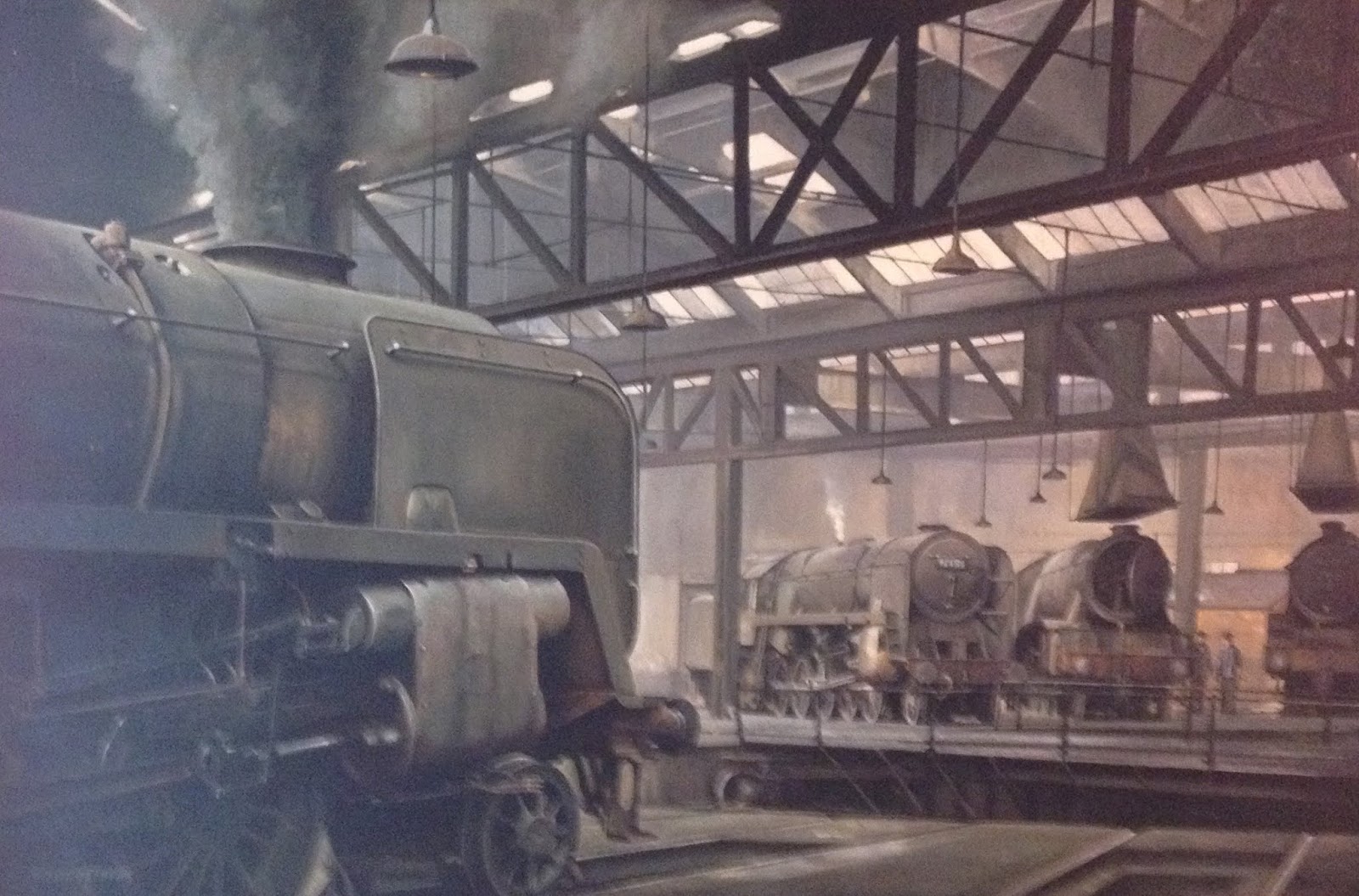
So, says the information board for the former GCR turntable at Penistone, describing the need for steam locomotives to face the direction they were going in. The heritage lines have also found them useful - at Quorn, Minehead and Churston, to name but three. The NRM at York provides demonstrations in the Great Hall, itself a former roundhouse, where the lines were typically arranged star-shaped around the central turntable.

Thanks are due to my friend, Andy, who came across the Penistone example during a recent bike ride, and passed on the pictures. Trawling through my own photos, I found my only turntable example was actually quite poignant, showing how - once balanced - one man could turn a Stanier Black Five, in this case, all by himself. The painting by Mike Jeffries is an appropriate reminder of how we remember them from the 1960s.


Monday, 27 April 2020

Good Hair Day


That was my first vain thought, when Ian sent me this picture, dated August 1966. Those were the days. Hairy. How important appearance was, though maybe not while going round the sheds. Hair was definitely the major consideration, along with the alarm caused by the sudden appearance of a spot. It never went much further than that, for me. Attire was not such a priority, though I did borrow my mum’s red cardie and some of her beads for Flower Power the following summer.

On that day, we went by car to Birkenhead, Edge Hill and Speke Junction sheds. Remaining steam was becoming increasingly concentrated in the north west of England but there was still plenty around at all three locations, though the variety of classes was becoming more and more limited - largely Stanier Class 5s and 8Fs, and Standards - especially the 2-10-0s, like this example No. 92134.  

Saturday, 25 April 2020

Daily Exercise


If I get my bike ride timing right, I can take a short breather next to the Castle Line. A farm track crosses the railway at this point between Rolleston and Staythorpe. Yesterday, I was just in time for the DMU and then the Class 60.


Friday, 24 April 2020

Castle Class


I thought the Castles were a bit special - a neat and pleasing design. I was always on the lookout round the sheds for that elegantly curved steam pipe that marked them out from the Halls etc. It was possible to see a few examples in a single day in Chester, even if we were moving on to Crewe for most of the time. John Dyer captured No. 5095 Barbury Castle at Chester in 1961, though my example, No. 4079 Pendennis Castle, was right at the end of things on a special train in 1967.


Wednesday, 22 April 2020

The GWR Grange Class


I find that I did not take any photos of Granges, or at least none that have survived. Even I had a cut-off point, it appears, beyond which a photo was not worth keeping. John Dyer collected a few shots of the class and the ones shown here are both handling freight trains. No. 6857 Tudor Grange is shown at Chester in 1962 and No. 6813 Eastbury Grange is entering Shrewsbury station in 1964, with the unmistakeable Abbey Foregate signalbox visible behind the train.

I loved going to both of these stations in the days of steam. I was so preoccupied with the trains that I don’t think I realised at the time that Shrewsbury station was adjacent to a proper old castle or that it crossed the River Severn at this point. Call yerself a geographer? I am grateful, as always, to John Dyer for permission to use his photos in this way.

Monday, 20 April 2020

Run, For It


As soon as they are able to walk, it seems, the young ones choose to run, instead. I’m sure I was the same. Why walk when you can get there quicker by running? Running adds an additional freedom. I can still get this buzz when I first get on my bike or swim into the sea. It’s liberating and exhilarating. Running, however, is currently on hold.

I ran home alone from junior school as it was safer than walking. We would run to the park [though maybe walk back]. We ran to Goodison Park from the station [and back again] and we ran to the sheds along the routes provided by Aidan Fuller in his shed directory. If we were shouted at by shed staff for trespassing, we probably ran away before trying again. Here at Shrewsbury, we did not run soon enough and got collared by the foreman. What a wonderful carefree pleasure it is to be able to run. I’m working on it……