Saturday, 26 August 2023

Making Tracks to Chester

We met up in Chester for the Making Tracks 3 model railway exhibition at Chester Cathedral, which runs until 2nd September. Based on Milton Keynes on the West Coast Main Line, the display is organised by Pete Waterman, and run his team of enthusiasts. This is the third and final time it has been to this venue. The man himself was in attendance yesterday to supervise proceedings. The event has been very well attended overall, assuming that the numbers present were a true indication of the support it has received over this month.

We arrived from east and west at Chester station, still a special place for me and full of memories from the early 1960s, when many days were spent on the platforms or on the steps leading up to the bridge carrying Hoole Road over the railway at the north end of the main buildings. The station concourse area is currently being refurbished, but the elegant façade remains unchanged. It was built by Thomas Brassey in the Italianate style and opened in 1848. It has Grade II listed status. Train services today are operated by Avanti West Coast, Northern, Merseyrail and Transport for Wales.

We took lunch at the Fork and Flavour café alongside the canal tow path between the station and the cathedral, which we are happy to recommend, as well as the cathedral café itself for a piece of cake and a nice cup of tea. My Avanti express back to Crewe was detained for half an hour over a police incident [a trespasser on the track] near Crewe Steelworks signalbox, meaning I missed my connection by ten minutes. What had been an hourly service back to Lowdham for most of the day had now suddenly lapsed to a two-hourly one plus the need for an extra change of train at Nottingham. EMR then provided a two-car rather than a 3-car Class 170 unit ensuring an overcrowded train with a number of people left standing in the aisles. In my experience, cross country trains are often under-resourced in terms of capacity. One is drawn to conclude that operators don’t care much about over-crowding, when, presumably, multiple units are considerably more expensive to run.

Extra time at Crewe gave me more time to reminisce over the changing railway scene there, too, plus a couple of photo opportunities, including a returning charter hauled by English Electric Type Four D213 Andania.


Thursday, 24 August 2023

Cleethorpes

There is something very welcoming about a terminus station that sits next to a promenade overlooking a sandy beach. Even more so, when the holiday season is in full swing and every arriving morning train brings more young families determined to enjoy all the typical attractions of a seaside resort.

Cleethorpes station was opened by the Manchester, Sheffield and Lincolnshire Railway in 1863, the station buildings and a distinctive clock tower being completed in the following year. The original station buildings on platform one were closed in 1961 and replaced with a modern structure facing the platform ends. The old GCR buildings have since been used for crew accommodation and as a pub.

Today the station is run by Trans Pennine Express, who provide hourly trains to Liverpool. East Midlands Railway run services to Barton-on-Humber and Northern Trains provide a daily train to Sheffield. Some of the 1960s buildings are presently unoccupied and the entrance is cramped and looks rather shabby, compared to the relative grandeur of the buildings that preceded them, none of which will put off the holiday makers as they round the corner onto that bustling promenade. As if to make the point, the sun came out the moment I stepped off the train.


Tuesday, 22 August 2023

Kidderminster station [SVR]

They’ve made such a good job of it. The south facing concourse - so well-lit by natural light yet sheltered by an over-all canopy - is enclosed on three sides and faces the platforms and buffer stops. Built in 1984 in a late Victorian style, it was based on the design for Ross-on-Wye, which opened in 1890.

Sitting on a pillar box red, ex-Post Office platform trolley to eat my sandwich, I felt perfectly at home surrounded by GWR-style paraphernalia and signage. It provides a very pleasing ambience. The SVR gives every impression of fighting back positively after Covid and its well-publicised financial problems. I’m hoping that by the time of my next visit they are even flush enough to provide the refreshment room with a modern coffee machine worthy of such a description. It would be one deviation from the convincing 1890s theme that I would be prepared to accept.


Monday, 21 August 2023

Railart 2023

The annual Railart exhibition of the Guild of Railway Artists began as usual on Saturday, in the room above the SVR’s Kidderminster station museum. It was opened during the preview event by Steve Davies MBE, director of the AI Locomotive Trust and former head of the NRM. All the steadfast luminaries of the GRA were in attendance and with new pieces to show. The guild’s work continues to be dominated by the triumvirate of Malcolm Root, Philip D Hawkins and John Austin, with admirable long-standing support from Eric Bottomley, Steven Warnes, Peter Annable, Gerald Broom and Rob Rowland, who surely can’t be far off fellowship of the guild, with his distinctive choices of themes and locations to add to consistently high standards of execution. Hats off, too, to David Halliwell, editor of the quarterly journal, the Wheel and Palette, for his insistence in adding the trainspotting generation to his pictures. The post-war railway scene was packed with people at work, plus the army of enthusiasts who were there to fix the life-long memories of their youth that still give so much pleasure today.


Sunday, 13 August 2023

Peterborough

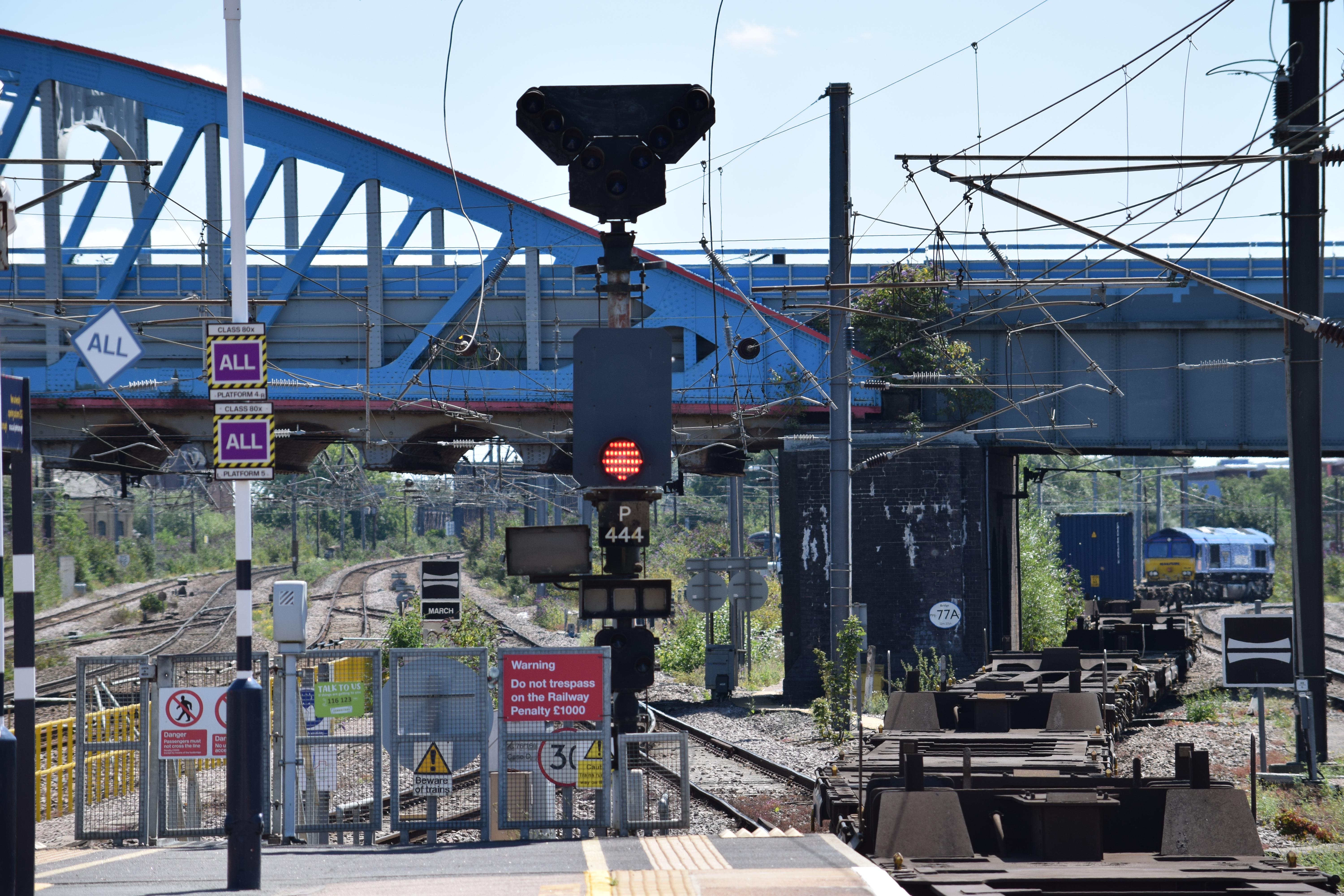
I had never stood on Peterborough station before, though the girder bridge just south of the station was instantly recognisable from the numerous magazine photographs I’d seen over the years. All the original GNR buildings from 1850 have been removed during the various stages of modernisation, except for the Great Northern Hotel, opposite the station frontage and recently at the centre of a kerfuffle, locally, over the Government decision to use it for housing asylum seekers.

The island platforms, added to in number in recent years, seem a little narrow and crowded, especially near the lifts and stairs. The ramps at the northern end allow an alternative and more leisurely stroll between the platforms. Although functional, the series of enclosed oblongs is a bit of an eyesore. As the station is busy with travellers making connections, there is a constant babble of audio information, and that’s even before any unexpected platform alterations are announced. Nevertheless, that is all very helpful stuff when the arrival of your connecting train is imminent. There are also customer information help points - with real people in there, too, which all seems very positive.

Peterborough has become a good place to watch Class 66s in action, but it was already a busy station before they arrived, as an important junction for cross-country passenger services connecting with ECML expresses. As the increasing number of shed-hauled freights often follow an east-west axis, the north-south aligned ECML was consequently somewhat in the way.

Remodelling, including revised track layouts, made for easier high-speed passage for trains that don’t stop here, as well as accommodating those potentially troublesome freights carrying Felixtowe’s containerised imports to the West Midlands and the north west. The required increase in capacity led to major engineering works north of the city at Werrington Junction and new alignments on the west side of the station. The underpass to the south of the station takes traffic below the ECML in the direction of the East Anglian and Thames estuary ports.


Friday, 11 August 2023

The Leominster and Kington Railway

Opened in 1857, this rural branch line was later extended to New Radnor. At Titley Junction two further branches were added, north west to Presteign and south to Eardisley. Run by the GWR after 1898, the line closed to passengers in 1951 and completely in 1964. In 2005, a one-mile section of track was re-established at Titley and named the Kingfisher line, privately owned and with limited access.

Our recent wanderings between the black and white villages of Herefordshire by bike brought us to the old station building alongside the station master’s house at Pembridge. The new occupants of the station master’s house said that they had found little left to remind them of its railway past, though a truncated distant signal post with arm and finial still in place in the garden next to the former level crossing was a more obvious reminder.

At Almeley on the Eardisley branch, we found the former station house was now a secluded private dwelling. The adjacent bridge over the minor road here has long since disappeared, though the stone abutments still stand, now covered in ivy.


Thursday, 10 August 2023

The Worcester, Bromyard and Leominster Railway

This short-lived branch line was not opened as a through route until 1897. By this time, it had been taken over by the GWR. It was closed to passengers in 1952 and completely in 1964. The track bed was then sold off to the original private land owners. Though there are a few recognisable sections, where the railway’s heritage is visible, much of the course of the railway has been returned to farming land, as in the valley bottom below Docklow, as shown in the pictures. For such a lightly used railway, one wonders why it was thought necessary to build a bridge with lengthy approach ramps, requiring considerable earthworks on either side, when a flat crossing would surely have sufficed.