Thursday, 27 April 2023

Disappointing Didcot

There is nothing disappointing about GWS Didcot, as we were reminded only last year. The station is another matter. It has barriers, so no access for passing strangers like us, arriving by car on this occasion. Not only that, its surrounded by high, black, spiked fencing, so there are no easy ground level photo shots of trains. We walked up the ramp to the footpath that crosses the line to the west before dropping down to the enormous, modern high-rise car park. The walkway is cladded with high steel sheeting – a monotonous extent of grey with just enough room to peek over at a stretch. From the top of the overbridge, the only viewpoint looks down on a forest of catenaries and all the other paraphernalia of electrification. It was all very depressing.

The town centre is not up to much, either. Established shops line the main east-west road through the town, running parallel to the railway but separated from it by a vast car park and modern retail outlets. We did not locate any notable historic core, though the Cornerstone Art Centre was bright, airy and welcoming with a spacious gallery display space for artists and a nice café - assuming you like bagels.


Friday, 14 April 2023

Rugby

Continuing my series of treks to discover junction stations I have never previously visited, and following Leamington Spa and Huddersfield, I descended yesterday on Rugby. I knew it as the former crossing place of the LNWR main line by the GCR, though no trace of that remains today. Rugby’s situation as a 7-way junction is also a thing of the past, reduced now to four [minus those to Peterborough, Leamington Spa and Leicester], in the directions of Euston, Northampton, Crewe and Birmingham.

It’s a funny old set-up at Rugby. A vast, central island platform is flanked by two much more recent affairs. Occupying the middle one is an enormous red brick monolith, opened, as the plaque indicates, from 1886. To photograph it, I had to leave the station, walk to the far end of the adjacent car park and raise my camera above the serious-looking metal fencing of the type that Network Rail just can’t get enough of.

The platforms are linked to the exits on either side by a subway. The modern entrance on the south side of the station is externally quite presentable, if a little cramped once inside. Barriers are in operation at both ends of the subway. The main building is partially hidden by modern canopies that replaced the overall roof, which I remember seeing in pictures from the 1960s. I walked right round the island building, looking for signs of life. In addition to the toilets, I found an information centre that seemed to be for railway personnel rather than for travellers. Avanti safeguarding officers [it said so on the back of their uniforms] came in and out of there with some regularity and sometimes three at a time. We were being very well guarded at Rugby. A bike shop announced its presence in one of the spaces at floor level, thought it appeared to be closed, and a cavernous waiting room, now a customer lounge, occupied another. Mainly, the enormous building did not seem to be being used at all. There wasn’t even a functioning buffet, though I did notice an arrow pointing to a WH Smiths and presumably some take-away options? Online, Avanti makes no mention of refreshments under station facilities. However, Network Rail’s site suggests they do exist, but maybe they meant the WH Smiths shop. Anyway, I couldn’t find it and so I went back to Nuneaton to get a cup of coffee.  

The question is, I suppose, what is to be done with substantial Victorian railway buildings in the modern age, now that patterns of use have dramatically changed. I don’t want them to be knocked down but I accept that maintaining them whilst they do nothing is costly in itself. Creative management would seem to be the answer - how to persuade organisations to make use of the opportunities provided by some solid edifices that don’t always have [as here] immediate road access but are available at [presumably] cheaper rental rates. I left Rugby thinking that it was one of the least welcoming and incongruous of stations I can remember visiting - windswept and soulless. I have no idea what, if anything, happens in all those upstairs rooms, which are only visible at a distance from the station.

In 1866, Charles Dickens waited between trains here after a fire in a carriage on the one on which he had been travelling north. Receiving short shrift from the manageress in the refreshment room, he got his own back in the short story, Mugby Junction, in a thinly-veiled disguise of the target of his piece. At least he had found one, and it was open.


Saturday, 8 April 2023

Paddington

Bearing in mind that it was in May 1972 that I had taken my only one-week, all-line rail-rover, Paddington station was now on the agenda again. On the 28th of that month, I had travelled down in the afternoon from Lime Street to Euston via Birmingham, barely leaving myself enough time to get to Paddington for the 11.45 overnight sleeper to Penzance, which I then took as far as Plymouth. Unfortunately, I had not booked a berth and my night “on the cushions” was just about bearable without any sleep, as I fidgeted away for hours trying to get comfy. It gave me a banging headache that I remember to this day. As dawn broke, and I got my bleary-eyed bearings, I wondered why all the world’s rabbits had suddenly descended on the West Country. It is my second strongest recollection of the journey.

I see now that I was hauled by D1011 Western Thunderer. Arriving at Plymouth at 06.35, I also notice that I set off straight back towards London on the 07.35, hauled as far as Exeter St David’s by D146, where Type Three D6510 was presumably waiting in the loop with stock destined for London Waterloo later that day. From Exeter to Bristol Parkway D143 was in charge and from Parkway to Paddington I was behind D1029 Western Legionnaire on a service from Cardiff, which was due in at 12.49. During my brief stop-off at Parkway, Type Two No. D5180 drifted through with three of the short-lived Hymek Class Type Threes, no doubt on their final journey to a South Wales scrapyard.

Over fifty years on and I was back at Paddington, this time joining the Heathrow Express bound for Terminal Five. A combination of being on the wrong side of the carriage and the speed of the train meant I missed most of the diesel locos on the main line and we were soon in the tunnel to the airport and travelling at a fraction of the speed. On the way back I made sure I was sitting on the correct side of the coach but it was a quiet, early Sunday morning with not much doing on the north side of the tracks into the capital.

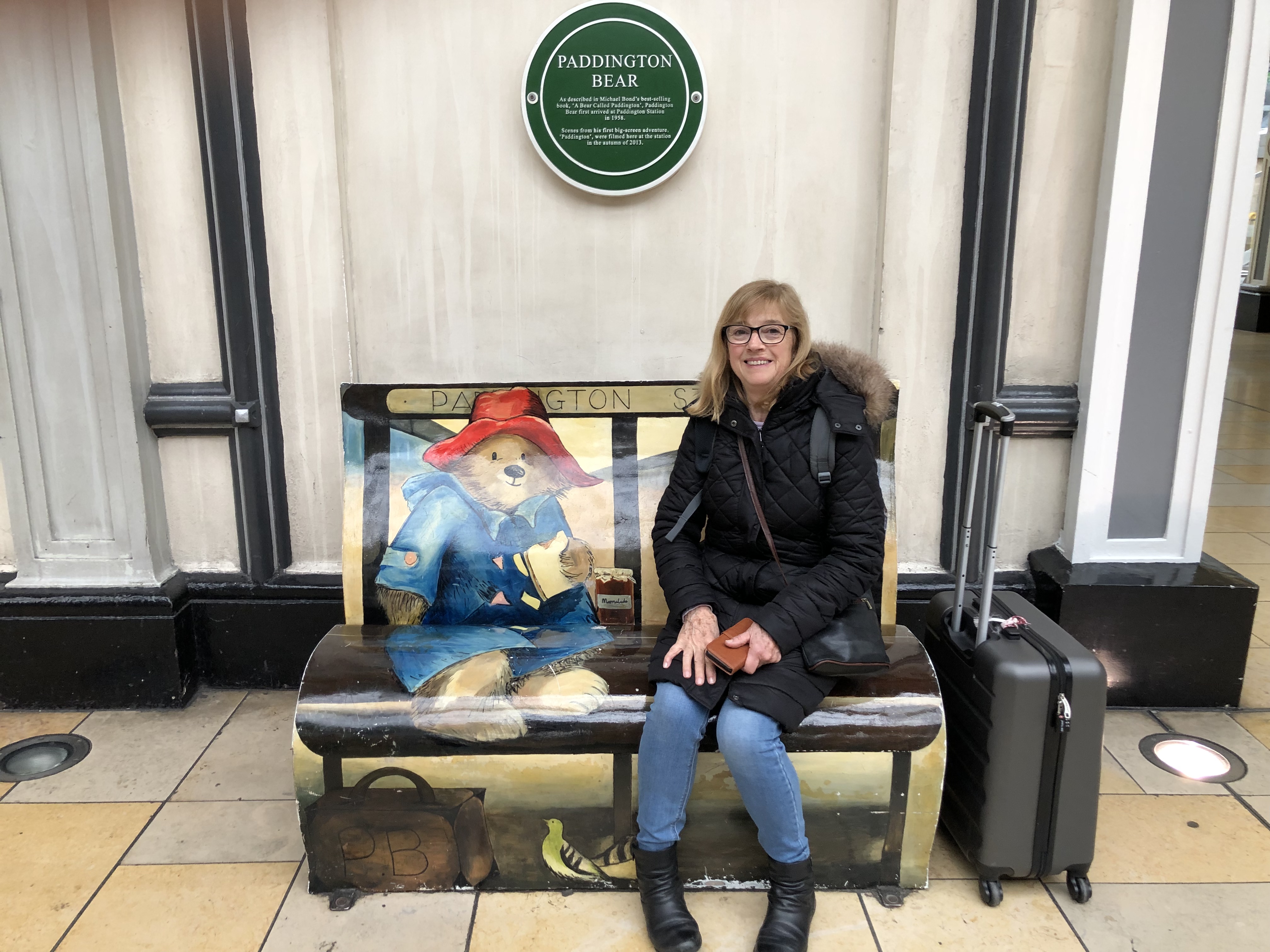
We had a wander round the station. Having hoped to admire the overall magnificence of the place, I was a little disappointed, though the original train shed certainly fits the bill. I don’t think the commercial café and retailing bit works as well as the similar provision at either KX or St Pancras. It seems somehow very detached from the rest of the place, as is the former station hotel, now the Hilton Paddington with its nevertheless impressive facade. Even in the side street where you catch the buses, you could really be anywhere that wasn’t immediately outside one of the country’s major terminus stations. It all seems very hemmed in by development and they clearly haven’t finished with it yet, as much of the north side of the approach is hidden behind hoardings. It looks like they are going to squeeze even more new bits into an already over-crowded scene. Reminders inside the station, however, of how much Brunel managed to cram into his short lifetime, with quaint sections of former offices, waiting and refreshment rooms alongside platform one, adorned with the old GWR art deco logo as the give-away features, were much more to my liking. We also found Paddington bear, of course, and a photo opportunity with the grandchildren in mind. Paddington is not an overly bearly sort of bear, of course, but getting down to the bare bones in order to lay him bare entirely would be a bare-faced cheek that could lead to a bare-knuckle encounter and who would want that.


Thursday, 6 April 2023

The Alexandria and Fredericksburg Railway

The A&FR of 1872 became part of the 113-mile-long Richmond, Fredericksburg and Potomac Railway in 1904. Washington commuter services are provided today by The Virginia Railway Express, while longer distance passenger trains on this important NE to SE route are run by Amtrak. Both are diesel locomotive-hauled. The modern development of Woodbridge station was completed in the Georgian Revivalist style in 2010. Fredericksburg station was restored in 2011. The old station building is now occupied by restaurants. It dates from 1910 when it replaced the 1837 [and, therefore, very early] original version.

Our brief visits by car to both stations coincided with passenger train arrivals, though the route was actually busier with freight. Walking the Civil War battlefield site at Fredericksburg, the tranquillity of today was in stark contrast to the mayhem that took place there in the 1860s. It was broken only by the mournful wail of the diesel locomotives pulling their long rakes of mixed freight trains through the riverside town.

The photos show Amtrak No. 124 calling at Woodbridge and a VRE double-decker commuter service pulling into Fredericksburg. 


Monday, 3 April 2023

On the bank at Toton again

Its very sticky after rain. The bank is essentially a great blob of boulder clay, so it holds the water on the surface and provides a slippery mess, though the regular dog walkers, horse riders and a handful of intrepid train spotters are not to be deterred. I doubt that there is any location in the country where you can identify as many locomotive numbers at one time without trespassing on railway property. You do need binoculars or a telescope, mind. Bridge cameras with built-in zooms will also do the trick. Productive as it is, its also a little frustrating that there are at least as many locos again that you can’t make out because they are inside sheds or behind other engines. Continuing my intermittent Sunday shed visits yesterday - a pattern begun over 60 years ago in Birkenhead – I still get the buzz [just not quite so intensely]. 


Friday, 31 March 2023

Marylebone

I had never been to Marylebone. In fact, I’d never even seen it, tucked back as it is from the bus routes along the Edgware Road between Euston and Paddington. This, in spite of my fairly substantial length of time spent further up the line as a volunteer on the modern GCR. I was visiting HQ for the first time to pay my respects to Watkins, Fay, et alia, and the extraordinary vision - not just for deciding to plonk yet another main line linking the north with London alongside all the others, but as a means of reaching the continent by a rail tunnel, an idea that was decades ahead of its time, as it turned out.

Compared to the other London termini, Marylebone is a modest affair, yet its red brick façade is elegant and pleasing to the eye. From our hotel, we had a good view not just of the porte cochere with its wrought ironwork and glass canopy, but also of the direct link undercover to the rear entrance of what is now the Landmark Hotel. This is the former Hotel Grand Central, opened in 1899 at the same time as the railway, itself. It faces south onto the main road and in so doing both dwarfs and partially hides the station frontage. You can pay a lot for B&B just over the road from where we were staying. I guess you get a lot more for your money than the attention of a uniformed doorman, but that question may have to lie unanswered for the time being.

Marylebone had all the bustle you would expect of a modern London destination, with a variety of food outlets and other services. Trains out of here are largely provided by Chiltern Railway to the West Midlands, in addition to the suburban commuter services north west of the capital and to those prosperous market towns beyond, in that hilly, red kite countryside.


Tuesday, 28 March 2023

Crewe [Again]

I shall never tire of going to Crewe. Although it has changed in many ways, it still draws me in as it always has done. It is also one of the easiest stations to park your car [free, street-side, behind Weston Road]. A farming village until the railway arrived, Crewe grew to become the archetypal railway town. The imposing Crewe Arms was the 1837-built station hotel for the Grand Junction Railway, largely rebuilt in 1880. Royal Scot Class No. 46115 Scots Guardsman was at the head of a charter train on Saturday 11th March – by no means the first time I’ve seen a Scot head off south from here.