Wednesday, 22 December 2021

After a brief interlude – 1 The Keighley and Worth Valley Railway

It’s now more than 50 years since steam ended on BR. Luckily, by the late 60s and early 70s, some within our group of friends were driving cars – either their own or their parents. This enabled us to search out steam on the newly forming heritage railways, instead. On our first such venture, Andy took us to a snowy K&WVR in February 1969. On the way, we called in at Birkenhead sheds and Spring’s Branch, Wigan, which, unsurprisingly, were both full of diesels, though I was struck that no-one seemed at all bothered that we were there, much like it had been in the last days of steam.

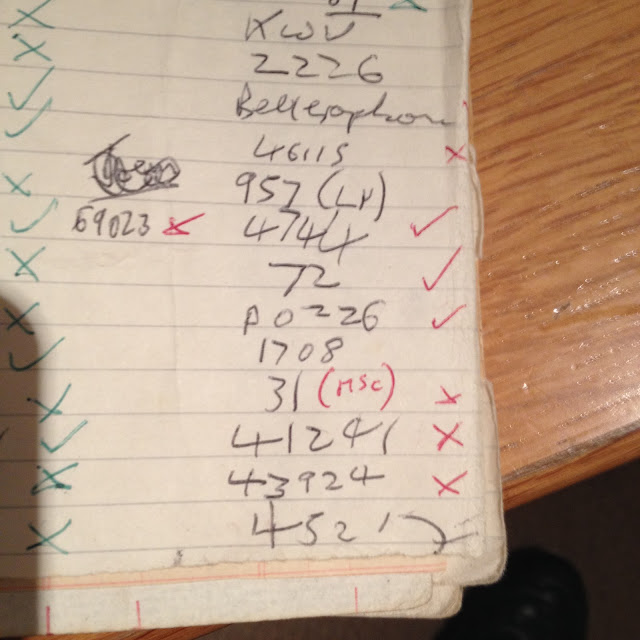
We did not travel on the K&WVR but visited both Haworth yard and Oxenhope, at the top of the line. It was freezing but I don’t think you really notice the cold when you’re 20. My somewhat cursory and scratchy notes, written on a scrap of paper on the day, record the locos that were present at Haworth. Little did I know that I would drive Joem, myself, one day [though only for a short time!]. We were also heartened, no doubt, to see that Scots Guardsman had been rescued for the future – another engine that would cross our paths again.


Tuesday, 14 December 2021

Buxton station

The London and North Western Railway and the Midland Railway both arrived in Buxton in 1863. They established their own stations on adjacent sites. Joseph Paxton designed the twin stations, and the parallel train sheds were constructed from local stone. The ex-MR station was closed in 1967 and the buildings were removed. The approach to the remaining station is dominated by the surviving and rather splendid half-circle fan window - a reminder of the former overall roof. It was restored in 2009 and has the original company’s name carved into the stonework above the glass.

Today, Class 150 units provide the Northern service to Manchester Piccadilly. No. 150135 was waiting to depart with the 13.56 to the city on Friday 10/12/21. The statue of “Joe” on the platform was named by the comedian, Alexei Sayle, in memory of his father who worked on the railway as a guard. It was made from scrap metal recovered from the local former traction maintenance depot - once a major employer in the town.


Thursday, 9 December 2021

Music to the ears

Diesels sound different - Growlers growl, Ventura engined HSTs scream and Hoovers - well, they can make a noise like a vacuum cleaner. That Deltic blowing off under the train shed at Leeds Central did have a certain attraction, though I’m not sure that I ever saw being engulfed in clouds of acrid blue smoke as much of a plus. We were children of the age of steam and our senses were ignited by the smells, sights and sounds of it. Diesels were never going to be able to match up.

The beat of the steam engine was accompanied by the beat revolution. Our platform end experiences were accompanied by an explosion of musical innovation. When not note taking, we imitated our heroes by twanging imaginary guitars, and whistled, sang and misquoted lyrics throughout the day. The Beatles, the Stones, the Kinks and the Beach Boys seized our attention and soared through our consciousness. It’s difficult to convey just how strongly we identified with each new sound and thought of it as somehow belonging to us – House of the Rising Sun, Strawberry Fields, Like a Rolling Stone, See Emily Play, God Only Knows, Space Oddity.

The blossoming didn’t stop when steam finished or the Beatles disbanded. The music just kept coming. I nailed my colours to the prog’ rock mast as well as to Westerns and Warships. The Nice, Vanilla Fudge, Pink Floyd, Yes, Supertramp, Genesis and Procol Harum accompanied me on nationwide rail-rovers, collecting and photographing diesels and electrics - because that was all there was - but by road, too, visiting the embryonic heritage railways for a fix of steam.

I think that’s when my musical clock stopped, because these are the bands I return to time and again, just as I can’t keep away from the Severn Valley Railway or our own Great Central. This is where the mood music is played out now – the thoughtful, tuneful, melodic arrangements of Gary Brooker, Roger Waters, Roger Hodgson and Tony Banks that took the genre as far as it could go. I’m just so grateful to them. Humming chords on a railway platform has a lot to be said for it. Its music to the ears.


Saturday, 4 December 2021

Original railway art sold at railwayana auctions in 2021

This summary covers all original paintings of Britain’s railways sold in railwayana auctions between 2011 and 2021. General auction houses that hold occasional railwayana auctions are not recorded, nor are those that periodically include some railwayana in an otherwise mixed sale. Additional railway paintings will also have changed hands in fine art sales held elsewhere. Nevertheless, this account should give some indication of the current trends in the railway paintings market. Auction houses have responded to the second year of disruption caused by the pandemic by providing alternative online sales in a variety of formats, in place of the previous live events. The overall quality of online catalogue photos to advertise paintings for sale has also improved. At least one auction house has split its sales over two days, with more lots included overall. There have been some very successful sales since operators were obliged to move online. The usual outgoings associated with staging live events have been avoided and some record takings have been announced. Many more railway paintings have been offered for sale this year than last and some personal collections have become dispersed. One auction included 50 railway paintings in a single event, though a substantial proportion remained unsold. The work of a relatively small group of favoured contemporary railway artists continues to sell well above the rates achieved by the majority.

1. The number of original railway paintings sold at railwayana auctions rose sharply in 2021: 2011 - 32, 2012 - 41, 2013 - 61, 2014 - 88, 2015 - 105, 2016 - 136, 2017 - 81, 2018 - 66, 2019 - 87, 2020 - 70, 2021 - 144.

2. The number of railway artists represented also rose markedly in 2021: 2011 - 25,

2012 - 20, 2013 - 27, 2014 - 34, 2015 - 42, 2016 - 48, 2017 - 31, 2018 - 25, 2019 - 25,

2020 - 33, 2021 - 59. 

3. The number of auction events that sold railway paintings rose in 2021, reflecting some organisational changes in response to the pandemic. At least one auction house arranged more frequent sales but with each containing fewer lots than in the former live events:

2011 - 7, 2012 - 10, 2013 - 13, 2014 - 19, 2015 - 18, 2016 - 22, 2017 - 18, 2018 - 14,

2019 - 16, 2020 – 16, 2021 - 25.  

4. In 2021, eleven paintings by six different artists reached or surpassed a £1,000 hammer price at railwayana auctions. Over the last eleven years, works by Don Breckon [20], Barry G. Price [16], Philip D. Hawkins [12] and Malcolm Root [10] have been most prominent in this category. The number of such paintings sold at these venues each year and the artists concerned were: 

2011 - 3 paintings, by Heiron [2], Broom,

2012 - 3 paintings, by Bottomley, Hawkins, Broom,

2013 - 8 paintings, by Broom [2], Breckon [2], Heiron, Root, Price, Freeman,

2014 - 7 paintings, by Root [3], Elford, Breckon, Freeman, Hawkins,

2015 - 11 paintings, by Breckon [3], Hawkins [2], Root [2], Beech, Ellis, Elford, Price.

2016 - 13 paintings, by Breckon [4], Price [3], Hawkins [2], Freeman, Root, Broom, Greene                

2017 - 7 paintings, by Freeman [2], Price [2], Broom, Root, Breckon,

2018 - 9 paintings, by Hawkins [4], Breckon [2], Price [2], Root,

2019 - 9 paintings, by Breckon [4], Broom, Cuneo, P. O. Jones, Root,

2020 - 7 paintings, by Price [4], Freeman, P. O. Jones, Shelbourne,

2021 - 11 paintings, by Breckon [3], Price [3], Hawkins [2], Fearnley, Broom, Freeman,

Mike Jeffries' roundhouse scene was just one of the paintings sold at railwayana auctions this year.
Friday, 3 December 2021

The John Dyer Photo Collection

I’m completing my trawl through John’s archive with a miscellany of shots taken in the north west of England and into North Wales between 1962 and 1965. It illustrates a variety of motive power, although locomotive numbers [and in one case an exact location] went unrecorded in these examples. This is a chance to revisit some regular haunts for us as former Merseyside spotters. Chester, Crewe, Preston and Shrewsbury were some of our favourite locations. I want to take this opportunity also to thank John once more for allowing me to share his photos in this manner, as well as for his work as an influential figure in the railway society at Wallasey Grammar School sixty years ago, now. As an assistant to the popular maths teacher, Jack Dugdale, John helped those of us who were a few years his junior to get about the rail network in a way that helped fashion a life-long affection for steam and for the railway scene in general.


Thursday, 2 December 2021

Excursions to New Brighton

John Dyer photographed some late 1950s and early 1960s excursions to New Brighton that were steam hauled but the locomotives were not identified. It’s mildly annoying to me that I can’t remember ever having seen a steam train in New Brighton, in spite of the fact that:

[a] I grew up there in the 50s and 60s

[b] New Brighton was our local station

[c] I liked steam engines quite a lot.


Wednesday, 1 December 2021

Westerns at Pewsey

John Dyer photographed these unidentified members of the class at speed through Pewsey in the late 1960s.