Tuesday, 15 December 2020

Aspinall 2-4-2T

 We knew where we were with Westerns because they only had four numbers. Southerns all began with a “3”, Midlands with a “4”, Easterns with a “6” and then there were the Standards. The “5s” were a bit of a mystery, however. I would go as far as saying that we weren’t actually that interested because none of them were namers, anyway.

So much for the perspective of the young teenage trainspotter. Aspinall designed his 2-4-2 tanks for the Lancashire and Yorkshire Railway in 1889, and they were built at Horwich works. The last of the class was withdrawn in 1961, by which time No. 1008 had already been preserved for the nation. They had originally been described as L&YR Class 5s, but for the LMS and BR their power classification was recorded as 3P.

John Dyer found these two examples in 1960, still at work on part of their old stomping ground between Liverpool Exchange and Southport. No. 50721 was shunting at Exchange and No. 50850 was at Southport Chapel Street.


Saturday, 12 December 2020

The Bowen-Cooke Class 7F

These London and North Western Railway 0-8-0s were first introduced in 1912 as Class G1. Further developments were made by Beames for the LNWR and Fowler, under the London Midland and Scottish Railway, in 1929. This left three consecutive classes of visually similar 7Fs that survived into BR days. Over 500 had been built originally and the last examples were withdrawn in 1963. No. 49395 was the only one to be preserved and is based on the East Lancashire Railway.

John Dyer’s photographs show No. 49099 on Birkenhead sheds in May 1960, No. 49406 at Buxton in August 1962, as was No. 49446. No. 49454 was on Crewe South sheds in March 1962, and No. 49509 was at Longsight in Manchester during the following month.


Thursday, 10 December 2020

Window of Opportunity

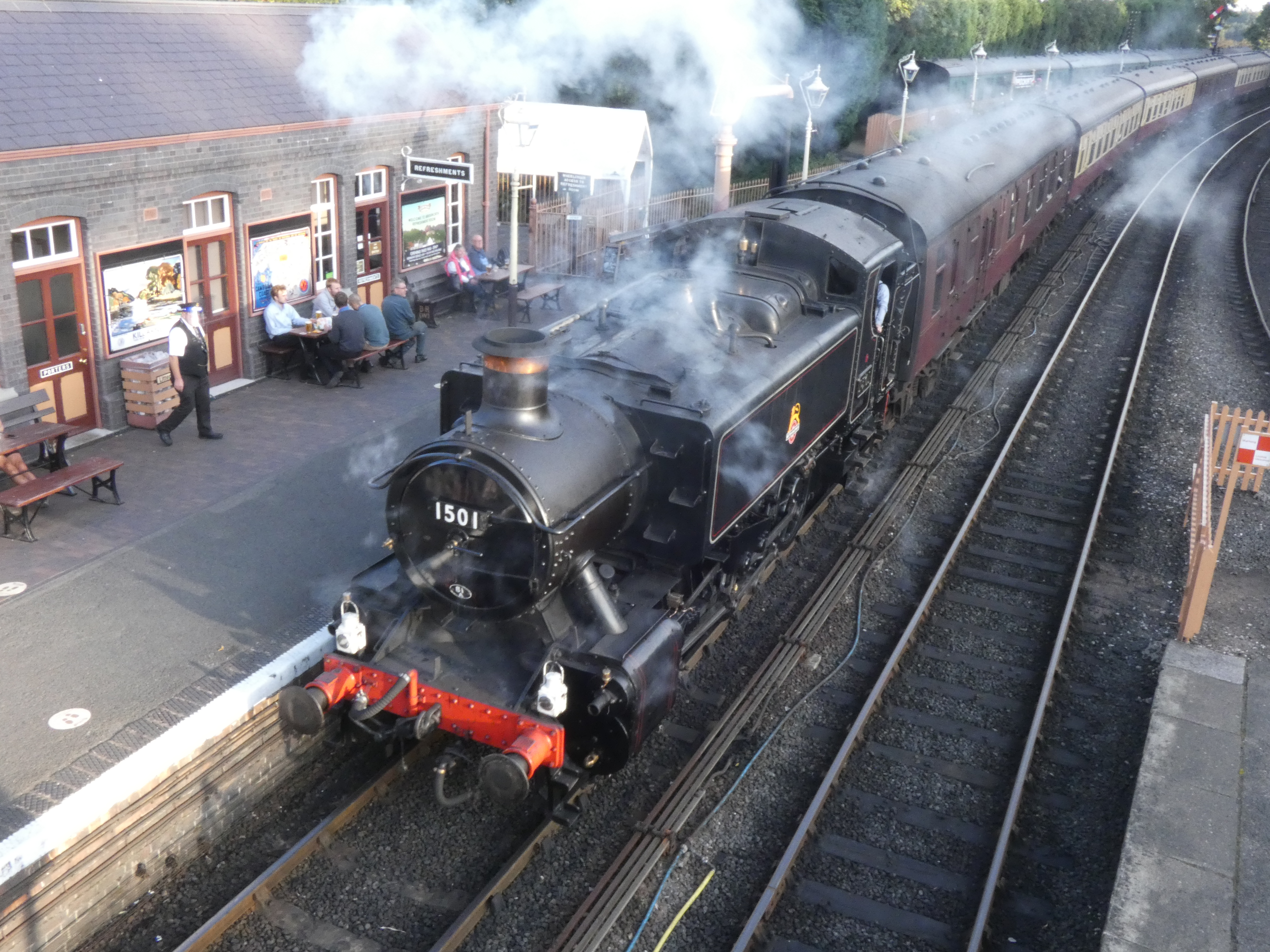
Opportunities to get out and about in the normal way have been seriously curtailed during 2020, but we managed a visit to the Severn Valley Railway between the waves and obviously struck a pleasant sunny day. I never bothered with sun glasses in the past, dismissing them as unnecessary fashion accessories until I was advised very specifically by my optician that I should think again.

The compartment was ours for the day and, as can be seen, the staff were taking the necessary precautions, too. The only place that was in “Crisis, what crisis?” mode was the pub at the end of the platform, where, apparently, it was still 2019, especially when the diesel-hauled special disgorged its full trainload at the end of the day. It was time to go home.

“But we’re all so fed up with it, and where’s the science that the hospitality sector is an important factor in spreading the disease?” You don’t need science to tell you that. It’s common sense. In fact, its so blindingly obvious I almost need my sun glasses on to see it.


Wednesday, 9 December 2020

The Stanier Class 8F 2-8-0s

These London Midland freight locos were largely unsung work horses and we probably didn’t give them that much attention at the time, with so many more glamorous engines around to entertain us. They were not as pleasing to the eye as the Stanier Class Fives. It was, perhaps, only after the end of steam on BR that the survivors became more noticeable. No. 48151, particularly, has become a stalwart of the preservation scene. The versatility of the class was certainly born out for me during a rousing return trip behind her over the Settle and Carlisle.

John Dyer photographed the class in a number of locations and I’ve chosen the ones that were closer to home - on the Wirral, at Chester and in North Wales. No. 48262 is on her way from Bidston dock to Shotton steelworks with an iron ore train in August 1962, and No. 48392 is similarly employed, departing from Bidston in May 1965. Freight traffic from the ore terminal and from Birkenhead docks had to snake its way across the electrified West Kirby to Liverpool lines at this point. No. 48406 was on Bidston sheds in July 1960, and No. 48476 was also there, in January 1962. No. 48633 passed through Chester General in March 1962, and No. 48742 was seen at Hope and Pen-y-fford on the ex-GCR route to Wrexham, in April 1962.   


Tuesday, 8 December 2020

Braunton at Taunton

In those carefree late summer days of 2019, we took the Riviera Express from Bristol to Kingswear. There was a water stop at Taunton, and I felt that I just had to get out and walk the platform that I had spent glorious trainspotting days on 56 years earlier, as a fourteen-year-old in 1963. As well as seeing half the Warship Class in one day, steam was still around, including Castle Class No. 7010 Avondale Castle.


Friday, 4 December 2020

Original railway art sold at railwayana auctions in 2020

 Only original paintings depicting railways in Britain and sold at the main railwayana auction houses during 2020 are added below, namely at GCRA, GNRA, GWRA, Railwayana Auctions UK Ltd and Talisman RA. The auction year’s live events have been severely disrupted by the pandemic, but all the auction houses have shown creditable ingenuity in adapting to challenging circumstances, by organising alternative online sales in a variety of formats. Results do not include general auction houses that hold occasional railwayana auctions, nor those that have a limited railwayana section within a mixed sale. Only lots containing paintings advertised in auction catalogues and listed as sold on the day are included. It is highly likely, of course, that railway paintings will also have changed hands in fine art and other sales during the same period. All of the information from which this summary has been taken has been available on the auction houses’ own websites. Railway paintings continue to make a notable contribution to railwayana auctions and examples of original artwork provide popular catalogue cover illustrations for many such auction events. The paintings of a relatively small group of leading railway artists continue to attract considerably more interest than the majority of the pictures brought to auction, which then tend to sell comparatively cheaply. 

1. The number of lots of original railway paintings sold at railwayana auctions rose from 2011 to 2016 and has dropped since then: 2011 - 32, 2012 - 41, 2013 - 61, 2014 - 88, 2015 - 105, 2016 - 136, 2017 - 81, 2018 - 66, 2019 - 87, 2020 - 70. 

2. The number of railway artists whose work was sold at the same auctions rose from 2011 to 2016 but has also been lower since then: 2011 - 25, 2012 - 20, 2013 - 27, 2014 - 34, 2015 - 42, 2016 - 48, 2017 - 31, 2018 - 25, 2019 - 25, 2020 - 33. 

3. Unsurprisingly, the number of railwayana auction events that sold railway paintings also rose from 2011 until 2016 and has fallen since then: 2011 - 7, 2012 - 10, 2013 - 13, 2014 - 19, 2015 - 18, 2016 - 22, 2017 - 18, 2018 - 14, 2019 - 16, 2020 - 16.  

4. In 2020, seven paintings by four different artists reached or surpassed a £1,000 hammer price at railwayana auctions. Over the last ten-years, work by Don Breckon [17] and Barry G. Price [13] has been the most successful in this category. During the last decade, the number of such paintings sold at these venues each year and the artists concerned were: 

2011 - 3 paintings - by Heiron [2], Broom,

2012 - 3 paintings - by Bottomley, Hawkins, Broom,

2013 - 8 paintings - by Broom [2], Breckon [2], Heiron, Root, Price, Freeman,

2014 - 7 paintings - by Root [3], Elford, Breckon, Freeman, Hawkins,

2015 - 11 paintings - by Breckon [3], Hawkins [2], Root [2], Beech, Ellis, Elford, Price.

2016 - 13 paintings - by Breckon [4], Price [3], Hawkins [2], Freeman, Root, Broom,

                                  Greene,

2017 - 7 paintings - by Freeman [2], Price [2], Broom, Root, Breckon,

2018 - 9 paintings - by Hawkins [4], Breckon [2], Price [2], Root,

2019 - 9 paintings - by Breckon [4], Broom, Cuneo, P. O. Jones, Root,

2020 - 7 paintings - by Price [4], Freeman, P. O. Jones, Shelbourne,  


Thursday, 3 December 2020

Jinties

Here are some excellent atmospheric pictures from John Dyer’s archive, featuring the LMS Class 3F 0-6-0 tank. We knew them as Jinties and they were plentiful on both sides of the Mersey and at Chester. They were the standard shunting tank engine for goods trains in our area and also used for station pilot duties and moving empty stock. As always, I’m very grateful to John for allowing me to share his splendid collection in this way.

This selection features examples at Chester General, Liverpool Lime Street, Liscard and Poulton and Bidston and date from between 1958 and 1965. Liscard and Poulton was the nearest station to our house and during my short stay at Poulton Junior School, it was on my way home, walking up Mill Lane.  I don’t remember ever seeing a train there, though steam and smoke from the Seacombe stoppers was visible from the classroom and the school yard as it drifted up from the cutting, which is now part of the Wallasey tunnel approach road. 

No. 47389 was at Chester in July 1964, No. 47414 was in Lime Street station in August 1965, Nos. 47495 and 47507 were at Bidston in 1962 and 1961, respectively, and No. 47622 was observed at Liscard and Poulton in 1958.