Saturday, 23 March 2024

Destination Crewe, Recycled

I sat on the plastic chair at the plastic table in the tiny cordoned off café space at the Gourmet Coffee Bar and Kitchen on platform 5 and drank an excellent one-shot Americano from my cardboard cup with its plastic lid. I’d had one on a previous visit and so I knew just where to head to. Ahead of me and at height alongside the footbridge was a rather plasticky looking notice “Destination Crewe HS2”, in BR totem style. It was as flat, faded and worn as the aspiration that put it there in the first place.

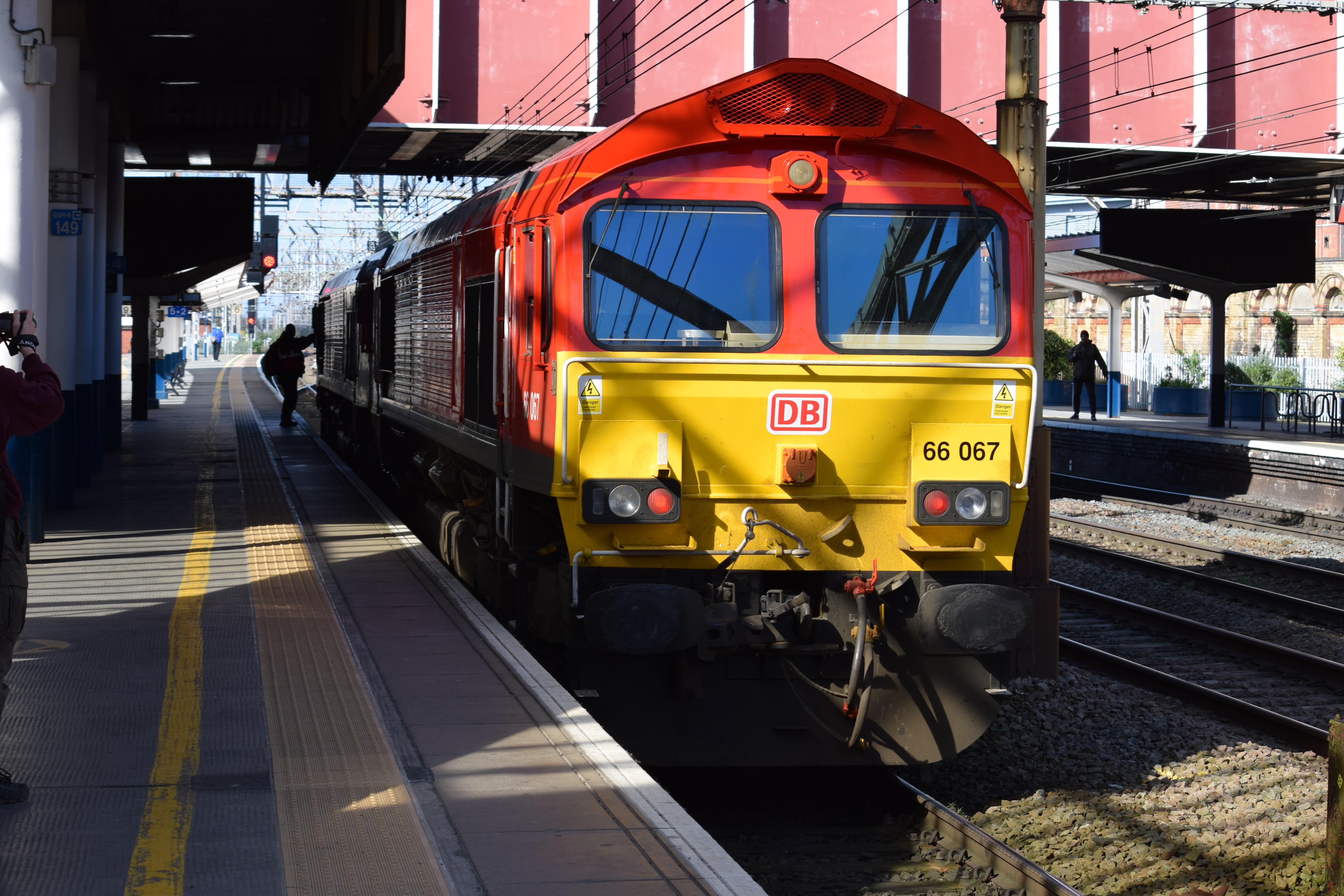
Crewe was certainly my destination for a few hours yesterday, however, on a breezy, cool, though largely bright and sunny day. Above the entrance to the original station buffet on platform 6 is the inscription “The Crewe Hero”. Perhaps they mean me, after all I’ve been coming here every now and then for over 60 years. The illustration of a Coronation Class locomotive, a type that used to grace this same platform certainly took me back. Maybe it was one of the rarer Polmadie examples arriving at 3 in the afternoon on the Glasgow to Birmingham express. That was the closest I got to steam yesterday, though a few heritage diesels did put in an appearance. It still draws me back, this place, and the chances of a return before long and another very decent cup of coffee are now significantly higher than the arrival of HS2 - and may even precede the recycling of the plastic sign.


Tuesday, 19 March 2024

The GCR Celebrates its 125th Anniversary

Last weekend, the GCR was 125 years old. In 1899, the London Extension was opened between Annesley and Quainton Road, thus connecting the old Manchester, Sheffield and Lincolnshire Railway in the north with the Metropolitan Railway in the Home Counties. This allowed expresses to travel directly for the first time from Manchester London Road to the new station at Marylebone, on the then newly renamed Great Central Railway.

The modern-day GCR has now been a heritage railway for longer than in any of its previous guises – GCR, LNER and BR. It is to the great credit of the volunteers who saved it from complete destruction in the late 60s and early 70s, and to those who have followed them since, that there is now a vibrant double track main line to enjoy, complete with its own branch line, and with plans well underway for a through inter-city railway connecting the southern edge of Nottingham with the northern extremities of Leicester.

The celebratory weekend included a get together at Marylebone on Friday and a two-day anniversary event back in Leicestershire and Nottinghamshire to emphasise the increasingly close links being forged between the current GCR at Loughborough and the GCR[N] at Ruddington, joined for the duration by shuttle buses running between the two.


Monday, 18 March 2024

The East Lancashire Railway

It was the lads’ train day on the ELR on Saturday. The event was the Legends of Steam weekend with 45690 Leander, 70000 Britannia and 60007 Sir Nigel Gresley. It was certainly well attended and Bolton Street station, particularly, was heaving during the middle part of the day. This was also my first opportunity to ride on the Heywood to Bury section “over the hump” that crosses the tram lines. The spacious car park at Heywood was easily accessible from the motorway.

The frontage of Bolton Street station is uninspiring. I thought back for rivals in the least attractive station façade competition and could only come up with Burton on Trent, at short notice. It resembles a 1960s garage premises, possibly offering services at the cheaper end of the scale. Once you are at platform level, however, the scene has changed completely and there is the flourishing and well renovated station in LMR colours that you would expect to see.

It was Saturday lunchtime in Bury, and going out to make the most of it is apparently a very popular thing to do. The first place we tried was bulging and we couldn’t get a table. This sent us round the corner to Wetherspoons, formerly the Art Picture House. Busy as well, we nevertheless managed to collect 6 chairs together round a table for 4 and elbowed our way through a substantial lunch in most interesting surroundings. The Art Picture House was designed by Albert Winstanley and completed in 1922. It is described as an example of post-Edwardian Baroque. Opening as a cinema, it then became a bingo hall before acquiring its current function, and it is now a Grade II listed building.


Sunday, 3 March 2024

Sir Nigel

I believe that I first met Sir Nigel Gresley on the 6th June 1963. There is a nagging doubt in my mind, though. In my notebook from the time, the middle number “0” in 60007 looks like a 6, though it couldn’t have been as there was no such thing as 60607. The number 7 is firstly crossed out and then reinstated above it, before being ticked as copped, and therefore - having just seen her for the first time – was underlined in my summer 62 com’ vol’ on my return home.

However, there is absolutely no doubt that we have met many times since then, and most recently yesterday. It was a fleeting reunion. She powered her charter to York through Newark at around 70, at a guess, somewhat short of the 92 mph that Bittern had managed on a similar journey, having been granted special license to really go for it in 2013. 60007 looked and sounded in really good nick, resplendent in early BR blue. However, as all the Streaks that I saw in the 60s were in BR green, that would still be my personal preference.


Friday, 1 March 2024

Pastry and Me

I thought I’d do a book about railway refreshment rooms. It had only been done once previously, as far as I could see, and that was by an insider and some time ago. I thought maybe that he was spilling the beans, though hopefully not in the dining car, after an abrupt switch to the slow line.  The more I wrote, the more I thought, this is really going to be quite boring - something that has admittedly not always deterred me, previously.

My life with pastry, on the other hand, has been a lifetime commitment. I know its not that good for me, but every now and then it’s OK, surely? Custard slice on my way to Llandore sheds in the 60s and countless mille feuillee on family holidays in France. I’ve sampled June’s excellent home-made pies - a reliable staple on the menu at the Plough in Farnsfield. A trip to see the albatross on the Yorkshire coast took us by chance to the Piebald Inn at Hunmanby, which proudly specialises in pies. It would have seemed rude to have asked for anything else.

Two other things put me off my station buffet book. The first was that the situation is dominated by corporate chains that have a reputation for blandness as the cost of predictability. You definitely know what to expect. The second is that many of the independent outlets have closed down since Covid as they were only marginally viable in the first place. Those sites would probably not have been overlooked by the chains in the first place had they been obvious money makers. The pandemic then led to a subsequent loss of footfall, endangering them further.

A combination of current circumstances periodically leaves me loitering near Greggs in Calverton. I’d heard about the success of their vegan sausage rolls, and you can mix and match meat and vegan at four for the very reasonable price of three. They are a little salty, but I really enjoy my little treat and I’ve found that they all get eaten. Still with minutes to spare, I announced my most recent purchases to my friends. Ian goes for a spinachy one from Gerrards, family bakers on the Wirral since 1838 at the relatively abstemious rate of one a year, Dave had his fix from Greggs in Uttoxeter services yesterday, and John goes the whole hog with a meaty monthly visit to Whiterow farm shop at Beckington, near Frome [he is there, as I write this!]

Railway catering will have to wait. I may even think of something else that is more critical and less tedious to bring to peoples’ attention. In the meantime, I’ll just keep on munching.


Thursday, 29 February 2024

Precedent Lincoln

Let’s be honest. If you were planning a town centre from scratch you wouldn’t plonk a railway level crossing straight over the High Street. That would especially be the case if you knew that road traffic volumes were going to rise, trains were going to run more frequently, and that one of the two stations would be earmarked for closure, thus funnelling even more trains than before over the road at the same point. In fact, Lincoln’s central area once had 5 level crossings, with two of them only 200 yards apart across High Street. It was certainly a recipe for getting things clogged up.

What was clearly needed was a mathematician, someone who could see the wood for the trees and realise that this just wasn’t going to add up. Luckily, Lincoln had such a man in George Boole FRS [1815-1864], whose recently erected statue outside Lincoln station recognises him as “the grandfather of the digital age”. Unluckily, Boole’s expertise came too late for the city’s railway builders. They’d already set their precedent by opting for level crossings from the off.

Lincoln’s response in recent times, additional to the closure of St Mark’s station and level crossing by British Rail in the 1980s, has been to pedestrianise the High Street and to build a footbridge across the railway so that people are not detained unnecessarily at the level crossing barriers. They have also added lifts to the bridge to ensure equal access for all. It’s difficult to make lift shafts that enhance the overall look of a place. As lift shafts go, these are probably above average in design terms.

Dipping in to online chat about Lincoln suggests that the High Street level crossing is still a topic of conversation, locally, with some even seeing it as a dividing point between “buzzing and cool” Lincoln to the north and “rather falling behind” Lincoln to the south. In the meantime, it remains a significant and characterful part of the city landscape, especially if you like trains and you’re not in a hurry.

George Boole was already an accomplished mathematician during the railway age, but it seems that it was not until 1937 that his work helped lay the foundations for modern computer and communications systems. From his present position, he can just about make out the High Street level crossing at the next corner. He’s probably muttering something like, “Mmm, not sure that’s going to work”. However, we idle passers-by have now got these two notable features of interest to attract our attention in this ever-changing part of the city landscape.


Sunday, 25 February 2024

Halifax

Nathaniel knew he was a Priestley, but he didn’t know quite how that had happened. An 1890 document stated that “Nathaniel Priestley, brazier or tinker, born near Bradford or Halifax about 1742, died 1828. Wanted his father’s name”. Presumably he knew who his mum was, though that is not recorded anywhere, either. What is known is that he was my Dad’s Great, Great, Great Grandad. The West Yorkshire Archive Service in Halifax holds hand-written Priestley family notebooks from the late seventeenth century onwards, so off we went to Yorkshire to see what we could find out.

The 11.15 Azuma from Doncaster was busy and on time. The elegant thirty-something foursome at the next table were up from London for a two-hour pre-booked lunch date in Harrogate. The upper middle class “Yah” now seems to have become an abbreviated “Yer” [but certainly nowhere near to a commonplace “Yeh”]. After Leeds, our Northern Class 195 DMU to Halifax was heading for the seaside at Blackpool with an altogether different clientele. I wondered if the cost of a weekend at the Lancashire resort for our six cheery fellow travellers was comparable to lunch for four at a fashionable restaurant in Harrogate.  

Central Halifax is full of character. The modern library that contains the WYAS is welded onto the remains of the Square Congregational church, dating from 1857 and still including the spire. This attractive and imaginative scheme was completed in 2017. Behind the ensemble is the Piece Hall, a magnificent Grade I listed masterpiece, constructed for the trading of woollen cloth by the thirty yard “piece”, in the eighteenth century. There are numerous solid Yorkstone buildings still surviving, from public and commercial to old mills with new functions. Since we were last in the centre of town, many of the narrow central streets have been pedestrianised, making it a very leisurely and welcoming place to stroll around.

The grand, old Grade II listed station building at Halifax was opened in 1855. The steel and glass structure that took its place on the adjacent site was completed in 2010, becoming the station’s new entrance and concourse. The original building became part of the tourist attraction, Eureka! The National Childrens’ Museum.  

There were no great revelations for us in the archive. Nathaniel’s dad did a very good job of concealing his son’s true identity - not only from his son but from the whole of his family thereafter. It was suspected, but never proved, that this was because he was a very wealthy man who was not married at the time - or, at least, not to the woman who bore this particular child. As a tinker and brazier whose own son married a 16-year-old gypsy girl, Nathaniel probably couldn’t ever afford a posh lunch in Harrogate, and maybe never made it to the seaside, either. However, the Priestleys can trace their ancestry back to that point 280 years ago and then beyond it over the many centuries that preceded the event. “Yeh”, we go right back - but then, of course, so does everyone else.