Friday, 11 August 2023

The Leominster and Kington Railway

Opened in 1857, this rural branch line was later extended to New Radnor. At Titley Junction two further branches were added, north west to Presteign and south to Eardisley. Run by the GWR after 1898, the line closed to passengers in 1951 and completely in 1964. In 2005, a one-mile section of track was re-established at Titley and named the Kingfisher line, privately owned and with limited access.

Our recent wanderings between the black and white villages of Herefordshire by bike brought us to the old station building alongside the station master’s house at Pembridge. The new occupants of the station master’s house said that they had found little left to remind them of its railway past, though a truncated distant signal post with arm and finial still in place in the garden next to the former level crossing was a more obvious reminder.

At Almeley on the Eardisley branch, we found the former station house was now a secluded private dwelling. The adjacent bridge over the minor road here has long since disappeared, though the stone abutments still stand, now covered in ivy.


Thursday, 10 August 2023

The Worcester, Bromyard and Leominster Railway

This short-lived branch line was not opened as a through route until 1897. By this time, it had been taken over by the GWR. It was closed to passengers in 1952 and completely in 1964. The track bed was then sold off to the original private land owners. Though there are a few recognisable sections, where the railway’s heritage is visible, much of the course of the railway has been returned to farming land, as in the valley bottom below Docklow, as shown in the pictures. For such a lightly used railway, one wonders why it was thought necessary to build a bridge with lengthy approach ramps, requiring considerable earthworks on either side, when a flat crossing would surely have sufficed. 


Wednesday, 9 August 2023

Leominster

Leominster station on the Welsh Marches line has just two platforms today, but there is evidence on the east side of a former third facing platform edge and some overgrown track, and a bit of research shows there were two more past that one in days gone by. These once served branch lines west to Kington and Presteigne and east to Bromyard and Worcester, both of which were closed in the 1950s. 

It was reassuring to see that the ticket office is still operating, although on a part time basis. The booking clerk suggested that he was expecting this to continue under the management of Transport for Wales. As with many country stations where original station buildings still stand, there are a number of boarded up former offices and waiting rooms which have not attracted any small businesses, or where such initiatives have subsequently failed. One wonders just how attractive the railway companies make these spaces to potential entrepreneurs, in terms of favourable rental terms.

I was pleased to see a south-bound locomotive-hauled passenger train in the form of Class 67 No. 67017, propelling four carriages and a dummy front-end Class 82 heading for South Wales. Our short journey from Ludlow was my first with a Class 67.


Tuesday, 8 August 2023

Hereford Revisited

My first visit to Hereford was in May 1973 to watch King Class No. 6000 King George V being prepared for action in the Bulmer’s siding. A lads’ train day saw us back in the city in April 1992. Hereford was our destination from Crewe, travelling behind Coronation Pacific Class 8P No. 46229 Duchess of Hamilton.

Last week we let the train take the strain from Leominster for a day out in Hereford. It’s a bit of a walk from the station to the centre, something that would not even have crossed my consciousness in earlier times. The Grade II-listed Hereford station, with its rather grand and extensive façade, is now managed by Transport for Wales, which seems a little strange on the face of it, with Hereford still being firmly in England. It was opened in 1853 for the Shrewsbury and Hereford Railway and later the route was run jointly by the GWR and LNWR. As well as serving the Welsh Marches line linking north to south Wales, it has an hourly West Midlands Trains connection to Birmingham New Street and is the terminus of the GWR Cotswold line to London Paddington, via Worcester and Oxford.

On the inside, the station is spacious and pleasing to the eye, though some parts would benefit from a lick of paint. There are some well-tended, raised garden beds on the island platform. Four platform roads are separated by two central tracks for the apparently infrequent freights. 


Monday, 7 August 2023

Brush Type Fours at Ludlow

We called in on Ludlow station while we were on a youth hostelling tour by bike on 12/4/65. By chance, I photographed a northbound express behind a two-tone green locomotive powering through the station without stopping. The Brush type fours were then quite new. The Class 47s, as they later became, were built between 1962 and 1968 at Crewe works and at Brush’s own HQ at Loughborough.

On 29/7/23, 58 years on, I returned to Ludlow station again, this time to photograph the returning Shrewsbury to Weymouth special Pullman train after a day out at the seaside. It was topped and tailed by examples of the class - one two-tone green, one BR blue, large logo - though sadly the light had faded by 10.00 p.m., so the resulting shots are a little blurred. 


Sunday, 6 August 2023

Berrington and Eye station

The attractive station buildings still stand as a private residence on the north to south, Welsh Marches route between Ludlow and Leominster. It was opened in 1853 on the Shrewsbury and Hereford Railway, becoming part of the GWR/LNWR Joint Railway. The station closed in 1958. The main line is still a busy double-track link through the border country. Before the re-routing of most inter-regional expresses via Birmingham, this was an important line taking traffic from the north west to the south west of England. We used it for family holidays from Liverpool as far as Taunton in 1963 and Bristol Temple Meads in 1964. I travelled south under this bridge on 27/7/63, hauled by Castle Class No. 4087 Cardigan Castle. Today Transport for Wales operate services connecting the north and south of the country, though by way of a sizeable English diversion. The bridge at Eye on the minor road west from the National Trust property at Berrington Hall crosses the line here. The wall is high and the bridge parapet makes taking pictures a little more demanding than usual.


Saturday, 5 August 2023

Mappa Mundi

The oldest map of the then known world that exists in the world today was made in Hereford in 1300. It’s to be found in Hereford cathedral in a much more recently added display space near the entrance to the chained library - itself a fascinating collection of ancient books. Unsurprisingly, perhaps, the map shows predominantly ecclesiastical centres with Jerusalem at the centre, surrounded by Europe, The Middle East, Asia and Africa.

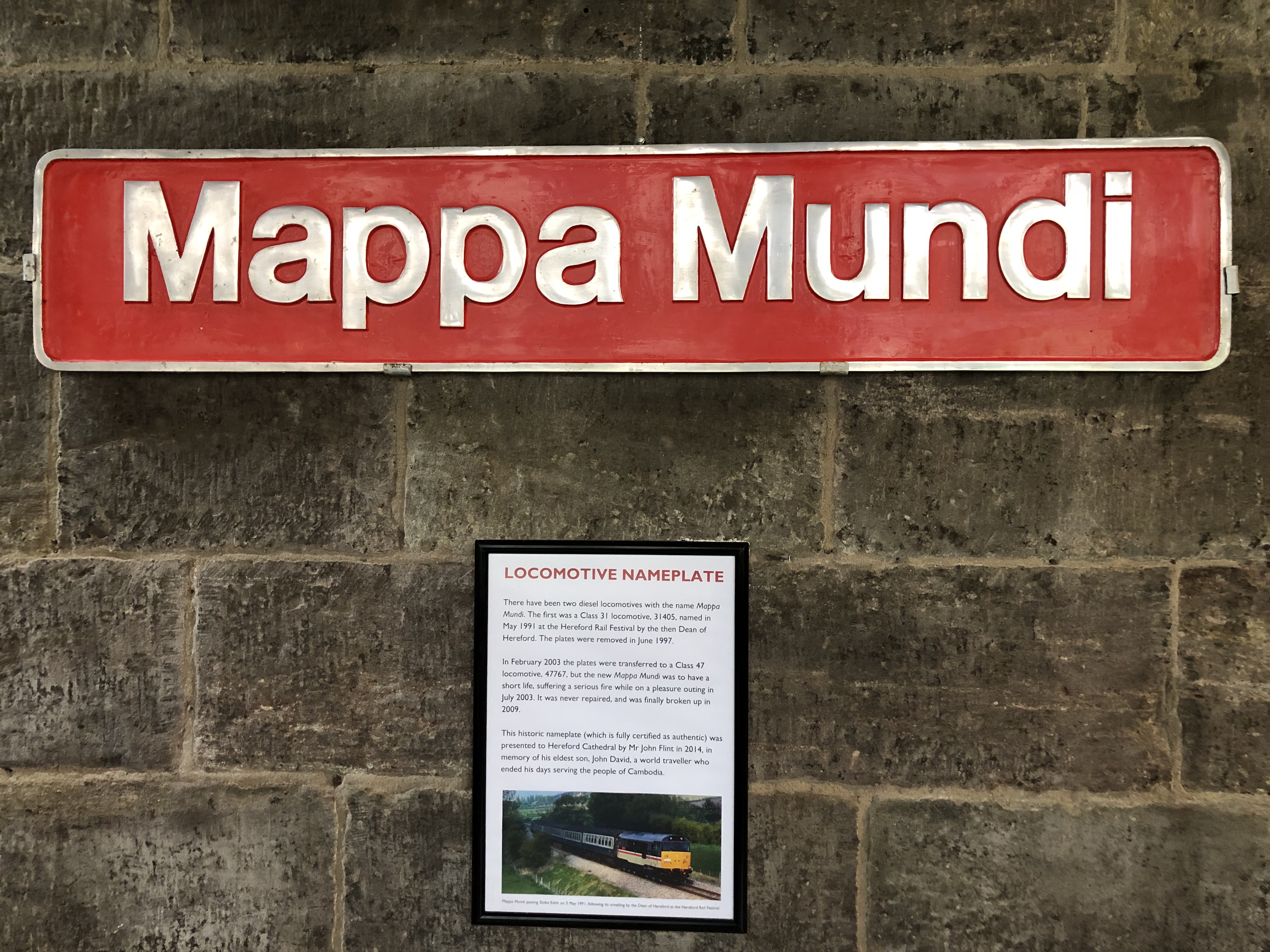
On the way in, we passed the nameplate Mappa Mundi, which was carried by two diesel locomotives, in turn. Class 31 No. 31405 bore the name from 1991 to 1997, followed by Class 47 No. 47767 between 2003 and 2009, as the accompanying plaque makes clear.