Friday, 11 September 2020

A bit of variety


Colas Rail Freight Class 56 No. 56096 was light engine on the Castle Line through Fiskerton station yesterday, on its way from Doncaster to Nottingham. At least, it offered a bit of variety to the normal diet.


Tuesday, 8 September 2020

The Jubilees


Jubs [not Jubes] were always welcome at the platform end. For a start, they were all namers and there were plenty of them to see. There were 186 of them, in fact, at the time of my summer 1962 combined volume. No. 45637 Windward Islands had been scrapped following the disaster at Harrow in 1952. No. 45609 Gilbert and Ellice Islands was withdrawn from service and scrapped in 1960, and No. 45616 Malta GC was cut up at Crewe works in 1961, as were No. 45619 Nigeria and No. 45630 Swaziland.
I got to see most of them, though 28 had eluded me by the time it had all finished. Four examples escaped for preservation, one of which is currently masquerading as No. 45562 Alberta, which was a massive stink as a relatively late survivor that always seemed to make an appearance wherever we went. No 45574 India was another Jub that followed us around a lot. Preston was great for Jubs, where the L&YR route to Blackpool crossed the WCML.
Here are some of John Dyer’s pictures of the Jubilee Class. Thanks are due to John once more for allowing me to use his archive in my blogs. No. 45577 was at Shrewsbury in 1964, No. 45600 Bermuda was at Manchester Exchange in 1962, No. 45608 Gibraltar was at Crewe in 1963, No. 45641 Sandwich at Derby in 1962 and No. 45697 Achilles at Chester in 1964.     


[I included No '600 to mark this 600th blog today - 600 for heaven's sake!]


Friday, 4 September 2020

Carriage prints that feature railway content


It might have been reasonable to expect that carriage prints - fixed above the seats and below the luggage racks in British Railways compartment coaches - would have featured views of trains with some regularity. However, most of the leading artists of the day who were commissioned to provide artwork for carriage prints seemed to have largely avoided views of the railway itself. As with the poster artists, they were mainly aiming to show off the natural landscape and cultural Britain at their best. The railway helped people make the connection, but was not going to spoil the view once they were there.
However, Hamilton Ellis produced twenty-four views that were very specifically of trains for the LMR Travel in…. series and some of the oldest of all railway pictures made up the LMS Travel on the Liverpool-Manchester Railway series, comprising of two prints by Isaac Shaw, each with two broadsides indicating possible arrangements for a variety of passenger and freight vehicles.
Other exceptions concentrated on bridges and viaducts, most notably the LMR railway architecture series of sixteen images provided by Claude Buckle and Kenneth Steele. Leonard Squirrel’s Stowmarket is the only other station building to form the main subject of a carriage print. A section of track makes it into the foreground of Lance Catermole’s River Dee at Cambus O’May, Aberdeenshire, though the artist did not wait long enough for a train to appear. Similarly, a nearby signal and signalbox are somewhat dwarfed by F Donald Blake’s Ben Nevis from Corpach, West Highlands. Kenneth Steele is the railway bridge specialist, with images of the Forth Bridge, King Edward Bridge at Newcastle, as well as Waterloo Bridge and Lambeth Bridge in London. S R Badmin is the viaduct expert, with Croxdale, Alnmouth [Northumberland], Berwick-on-Tweed and Welwyn all represented. 
Though railway bridges and viaducts appear fairly frequently, trains themselves are often not included, as in Holding’s Sunderland and F W Baldwin’s Beccles, amongst others. In some cases, like McDonald Patrick’s Tay Bridge, Jack Merriott’s Sandsend and Squirrel’s Colne Valley Viaduct, trains are included but observed from a distance, so that the type of motive power is not always easily discernible.

This leaves us with the very few carriage prints in which the train is a substantial part of the picture.  Cyril Barraud’s Class D49 locomotive, heading a train bound for Scarborough over the River Ouse at York in the LNER Original Etching Series, is closer to the artist, but is not the focal point of the picture. This leaves the work of just three carriage print artists, who have put the train at centre stage. John Greene shows an English Electric Type Four diesel at the head of a passenger train threading its way south along the West Coast Main Line in the Lune Valley and Reginald Lander depicts another modern image - this time of a diesel multiple unit - in the equally picturesque setting of the Lledr Valley, North Wales, though in both cases the train is very much part of the wider landscape.
Without doubt, though, the prize in this particular section of railway art goes to Richard Ward for his contributions to the Southern Region [B] Series, namely, Direct Electric Services, Golden Arrow, Atlantic Coast Express and perhaps his most easily recognisable and pleasing railway painting, Ocean Liner Express. The un-rebuilt West Country Pacific gingerly rounds the sharp curve as it exits Southampton docks bound for London Waterloo, sharing the frame with two equally impressive Cunard liners.  

Monday, 31 August 2020

A Loo with a View


The lounge area of our holiday home in St Ives had a panoramic view of the harbour and the Island [as is it known - even though it is not actually detached from the mainland]. Another floor up, our open-plan bedroom meant that one could enjoy a similar vista, either sitting in the bath or on the loo.
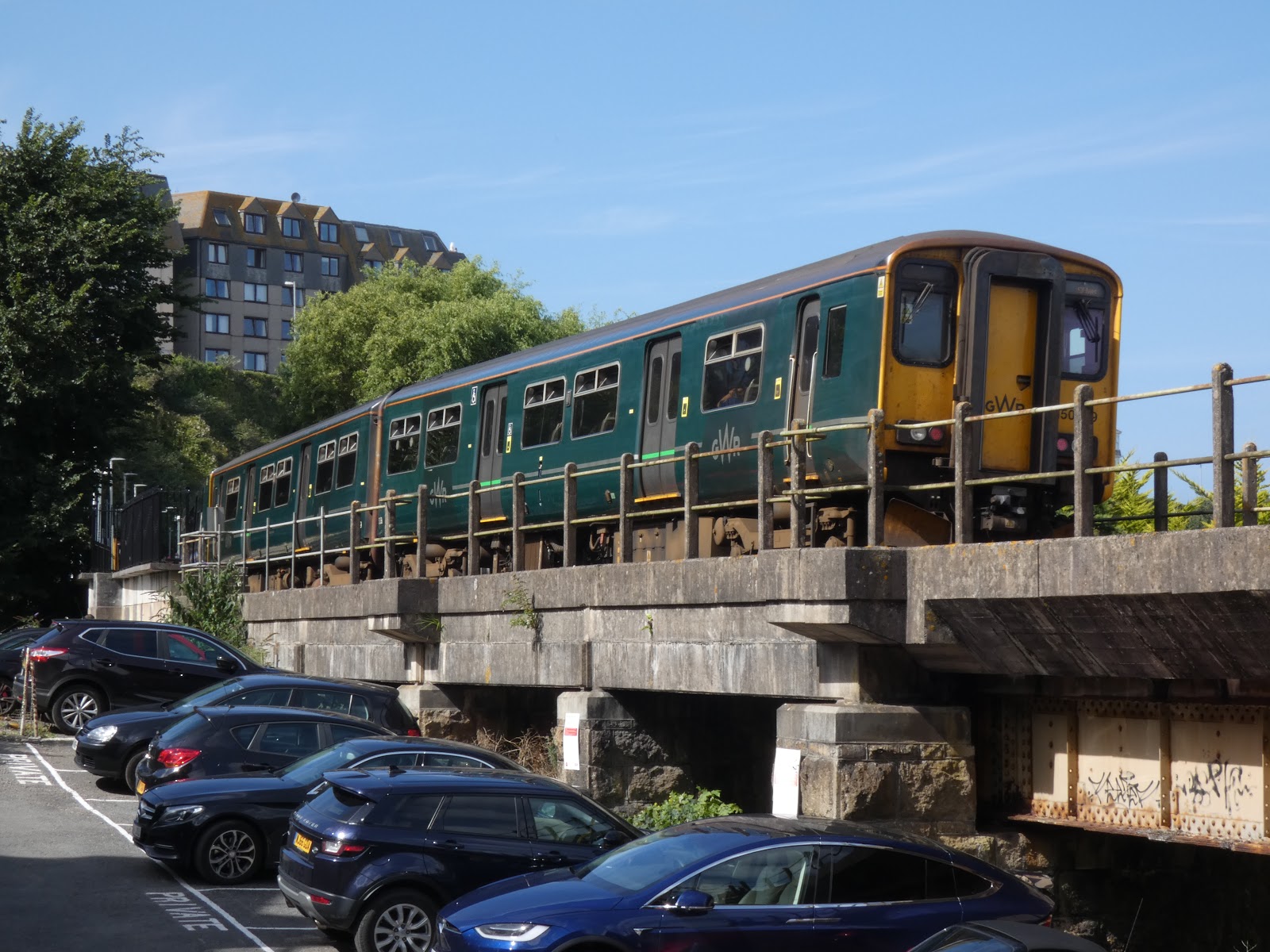
A short walk down Primrose Valley leads straight to Porthminster beach. The GWR shuttle service to St Erth, made up of a couple of two-car units, is seen leaving St Ives station and immediately trundling over St Ives viaduct. 

Friday, 7 August 2020

Call me Mr Fussy, but…


It was going to be a hot day, so I thought I’d go for the early train for a change. Always a chance of some wildlife while I wait. On Monday, a weasel had poked its low-slung sausage body out into the road just ahead of my front wheel. It saw me at the last minute and scurried back into the grass.
A couple carrying binoculars approached the gated crossing over the railway. “I can hear a willow warbler”, I offered. “Yes, I saw that. Once they’ve stopped calling you can only tell them from chiff-chaffs by the colour of their legs”. This was news to me, but its funny how that registered straight away as, “I am someone who always has to have the last word”.
They crossed the line but stopped at the trackside. “I should go through the gate, actually”, I said, “They are quite hot on that these days. I think they phone through and someone might come along”, thinking about some more recent railway police responses to trespassing incidents that I’d heard about. Instead of heeding my advice, the man just stood there and the lady went on a trackside walkabout between the down line and the metal farm gate. They really did not like being told, I thought.
The train was due. The barriers at Rolleston station came down and the signal changed to amber. “Its coming now”, I added in the hope that they would take the hint. “You can hear them before they arrive”, he exclaimed, “and they hoot for the crossings”. His wife finally went through the gate. I breathed a sigh of relief. I did not know if another train was coming from the Nottingham direction, while all our attention was directed towards the freight coming the other way. If so, she could have been taken unawares and put herself in real danger. At the last moment, he too withdrew to the right side of the gate.
“Arse”, I thought.
“Cheers, then”, I said.    


Wednesday, 5 August 2020

Ferret and Dartboard


A recent railway-themed letter to the Telegraph was drawn to my attention by a friend. The writer recounted how in the 1950s the Garter King of Arms had “an apoplectic fit” on discovering that the lion emblem on a locomotive’s tender had been turned round to face the right so that it faced the front of the locomotive. Unsurprisingly, he knew better than anyone that according to convention heraldic lions always faced left. The revelation presumably left those responsible at British Railways red-faced until they were able to phase out the offending articles and replace them with the correct version. As the contributor to the letters page reminded us, “these things need to be right”.
Blissfully unaware of the issue, myself, I thought the least I could do was get up to speed on BR’s lion emblems, even if I was over 60 years too late for it to have ever spoilt an otherwise enjoyable day out on the trains for me, personally.
The first “lion on wheel” emblem adopted for use on BR locomotives is attributed to the celebrated poster designer, Abram Games [though that is open to conjecture, apparently, as explained on the website thebeautyoftransport.com]
As it was an emblem/seal/totem/logo/crest and not officially heraldic, BR were free to have the lion facing the front of the loco on each side without infringing etiquette [or endangering the health of an unsuspecting Garter of Arms]. A replacement design was eventually introduced, also incorporating a lion and wheel, that was based on the British Transport Commission’s own coat of arms, which had been registered with the College of Arms in 1956.  However, BR continued its previous practice of having the lion facing the front on the right-hand side of the tender, and in doing so they infringed the terms of the registered design. After this faux pas had been pointed out to them, they phased out the offending version and after 1959 they followed the accepted practice. The new design was irreverently described as “the ferret and dartboard”, though what the Garter of Arms thought about that is not recorded.     


The replacement design became an instantly recognisable part of our formative years, even though I can hardly have claimed to have studied it closely at any stage. It is important to get it right, not because all convention must always be followed rigidly to satisfy the obsessions of people in high places, but because every artistic design is someone’s creation, even where it represents a large corporate body, and they deserve to have the integrity of their work upheld.

Tuesday, 4 August 2020

Pates


Pates, as we called the Patriot Class, came in two sizes. Un-rebuilt and rebuilt were very different engines to look at, yet the class as a whole was made up of a good mixture of both. Un-rebuilt locos seemed very old and chunky and some had already been withdrawn from service by the time of my 1962 combined volume. Rebuilt versions, with their tapered boilers and curved windshields, looked more like the Royal Scots.
John Dyer photographed both types - No. 45541 Duke of Sutherland was on Birkenhead sheds in April 1961 and No. 45531 Sir Frederick Harrison was seen at Stockport Edgeley sheds in August of the following year.