Wednesday, 11 December 2019

Happy Birthday, John Harrison - Railway Artist


John Harrison was born eighty-nine years ago today. Though never a train spotter, the London Midland and Scottish Railway was never far away while John was growing up in Lancashire, whether for holidays, shopping trips, family visits or the occasional commute if the buses weren’t running. After art training in Liverpool, John went on to become Head of Art in a large comprehensive school. Having eventually taken early retirement, he was able to concentrate on his own railway art. A full member of the Guild of Railway Artists - and formerly on the guild council - he adds, “my work is unashamedly nostalgic, seeking to recapture the men, machines and atmosphere of a departed way of life”. John Harrison’s work, with watercolour as his usual medium of choice, certainly exudes atmosphere - heavy grey skies, wet days, polluted air and railwaymen going about their business. John captures the gritty everyday reality of the steam railway in the 1950s and 1960s as well as anyone. Most competent railway artists communicate the appearance of the steam locomotive effectively in technical terms. It is skill on a different level to additionally bring to life railwaymen in their everyday surroundings as convincingly as he does. It was a pleasure to meet him yesterday and to travel back home with this particularly evocative John Harrison original - a glimpse inside Sutton Oak shed, entitled Memories of 8G. It is a scene so reminiscent of our own frequent visits to the next shed in the list - 8H Birkenhead. Happy returns of the day, John. Thank you for welcoming me and for sharing some of your own memories so readily.

Monday, 9 December 2019

Original railway art sold at railwayana auctions in 2019


Only original paintings depicting railways in Britain and sold at the main railwayana auction houses during 2019 are included below - GCRA, GNRA, GWRA [including their “buy and go” sales], Stafford and Talisman. The online auction at railwayana.net did not hold a sale in 2019. Postal auctions [as at GCRA] are not included below, neither are results from general auction houses that hold occasional railwayana auctions [as at Thirsk], nor any that have railwayana sections within mixed sales. Paintings that were in the auction catalogues but which did not sell on the day are not included. Other railway paintings will certainly have changed hands in fine art sales elsewhere during the same period. All the information from which this summary has been taken has been available in the auction houses’ own online archives. Railway paintings continue to make a noticeable contribution to the variety of objects for sale at railwayana auctions, and, unsurprisingly, examples of original artwork provide popular catalogue cover illustrations for many of those auctions. The work of a relatively small group of leading railway artists repeatedly attracts considerably more interest than the majority of the art works brought to auction. The prolific output over recent years from Guild of Railway Artists associate member, Joe Townend, continued in 2019, when 27 of his unframed paintings were sold at these auctions, contributing 31% of all the paintings sold.


1. The number of original railway paintings sold at the main live auctions continues to fluctuate: 2011 - 32, 2012 - 41, 2013 - 61, 2014 - 88, 2015 - 105, 2016 - 136, 2017 - 81,

2018 - 66, 2019 - 87.


2. The number of railway artists whose work was sold at these auctions in 2019 was the same as in the previous year: 2011 - 25, 2012 - 20, 2013 - 27, 2014 - 34, 2015 - 42, 2016 - 48,  2017 - 31, 2018 - 25, 2019 - 25.


3. In 2019, the number of railwayana auction events that sold railway paintings was more than in the previous year: 2011 - 7, 2012 - 10, 2013 - 13, 2014 - 19, 2015 - 18, 2016 - 22, 2017 - 18, 2018 - 14, 2019 - 16. 


4. In 2019, nine paintings by five different artists reached or surpassed a £1,000 hammer price at railwayana auctions. Since 2011, the number of such paintings sold at these venues each year and the artists concerned were:


2011 - 3 paintings - by Heiron [2], Broom,

2012 - 3 paintings - by Bottomley, Hawkins, Broom,

2013 - 8 paintings - by Broom [2], Breckon [2], Heiron, Root, Price, Freeman,

2014 - 7 paintings - by Root [3], Elford, Breckon, Freeman, Hawkins,

2015 - 11 paintings - by Breckon [3], Hawkins [2], Root [2], Beech, Ellis, Elford, Price.

2016 - 13 paintings - by Breckon [4], Price [3], Hawkins [2], Freeman, Root, Broom,

                                  Greene,

2017 - 7 paintings - by Freeman [2], Price [2], Broom, Root, Breckon,

2018 - 9 paintings - by Hawkins [4], Breckon [2], Price [2], Root,

2019 - 9 paintings - by Breckon [4], Broom, Cuneo, PO Jones, Root,  

Saturday, 7 December 2019

And for Christmas, Bob wanted to give her a drum [but why?]


I wended my way to the GC Railwayana auction at Stoneleigh with Bob Dylan for company, this time. When I’m on my own, I tend to listen to other peoples’ conversations for entertainment, though I realise that this is not necessarily an endearing characteristic. A stall-holder drew his visitor’s attention to a collection of luggage labels, which I gathered were a job lot from a previous [now, late] avid collector. “Very soon, nobody will know what they were”, he added ruefully.

On another stall, I noticed a blue enamel sign from LNER days. I was about to ask if I could take a picture of it when someone snapped it up. Perhaps he saw me eyeing it and decided to take the plunge there and then. It said something like “Please lock the back wheels of your bicycle”. I was just imagining the possible scenario that had made that sign a requirement, when it disappeared through the door in the company of its new owner, before being locked above the back wheel in the boot of a car.

I always gravitate to the paintings, these days. Once again, I’m tab-hanging. Do other people see what I see? Do they share my tastes about what makes a good railway painting? My guess is that both of these men next to me are too young to remember steam as an everyday occurrence on the main line in the 1960s. “The number plate’s wrong”. I couldn’t see that. It looked perfectly OK to me. “It’s in the wrong place”…. “He’s got that right”, he said, turning to the next painting, “..but it’s not so technical”. In this second painting, the engine is further away, so the same level of detail is probably not necessary [or even possible], though the perspective and the overall accuracy, I agree, is certainly present. They go back to the first painting. “The smoke’s wrong. It’s a shed scene. It wouldn’t be so thick”. I’ve heard this one before elsewhere, though coincidentally [and somewhat surprisingly], it was the same artist coming in for criticism. Then it had been a rather scornfully, “How can you have the smoke from two engines in the same painting blowing in different directions?”

When I got home, I checked out number plate positions when compared to photographs on Coronation Pacifics and Jubilees. Both paintings were accurate representations.

Smoke, however, is very variable stuff. It is perfectly possible for smoke to appear to blow from one locomotive stopped in a station in the direction of the prevailing wind and for the smoke from another locomotive travelling through the scene towards the former, light engine, to trail its steam in what appears to be an into the wind direction. For locos on shed, the possible variations in the amount, colour, density and direction taken by smoke emanating from smokebox chimneys are almost limitless. They might include - the state of the fire [firing up, building up steam or dropping the fire], the type and quality of the coal and the impact of hosing down, wind or lack of it [strength, direction, consistent or gusty], the open or hemmed in nature of the yard, the presence of nearby locos, nearby buildings [inside, outside, near or far, tall or single storey].

It makes a nonsense of trying to make definitive judgements about the circumstances on the day. You have to conclude that some people just like to try to sound authoritative even when they are not. My advice would be, if you weren’t there on the day and you only have the painting to go on, give the artist the benefit of the doubt. The artist was there [or at least had a photo to go on].         

Sunday, 1 December 2019

Crossed Lines


Hotels often display the worst examples of corporate art. So many spaces to fill, most of which will be subsequently ignored by most of those passing through. Something still has to be up there, otherwise it will look - well, quite empty. They are, by definition, mass-produced, but also frequently bland, with a tendency to smudgy, sloppy impressionist offerings that don’t really provide an impression of anything recognisable. Usually quite colourful, but too often garish, they might add a bit of variety to an otherwise blank wall, but fail to draw people in with any specific focus.

Not so, at the 17th century Wotton House Hotel, near Dorking in the Surrey Hills - the former residence of the botanist, diarist, designer and collector, John Evelyn. It is decorated with prints of the plants that he investigated, portraits of the family and a range of other themed exhibits. In the bedroom and above the headboard is a large-scale version of a Victorian map of the surrounding area, showing the routes taken by the two railway lines that crossed in the town.

The north-south line uses the Mole valley through the North Downs to connect London to Horsham. It was built by the London, Brighton and South Coast Railway and opened in 1867, serving Dorking station. The east-west North Downs line was opened by the Reading, Guildford and Reigate Railway in 1849. Great Western Railway services stop at Dorking West and Dorking Deepdene stations.

Friday, 29 November 2019

Oops, Missed It!


Luckily, Chris did much better with a panning shot on her phone. This is Salfords, in Surrey, and the Black Five was on its way to the south coast with a dining train from London Victoria on Tuesday 26 November. It sounded - and looked - as though she was going very well. I thought that I had already taken two pictures before this one, but it seems that I had not pressed the shutter right down on either occasion. Call yerself a photographer? Not really. And anyway, its a fairly new camera....and it was raining - quite heavily, actually.... 

Monday, 18 November 2019

Takes yer back


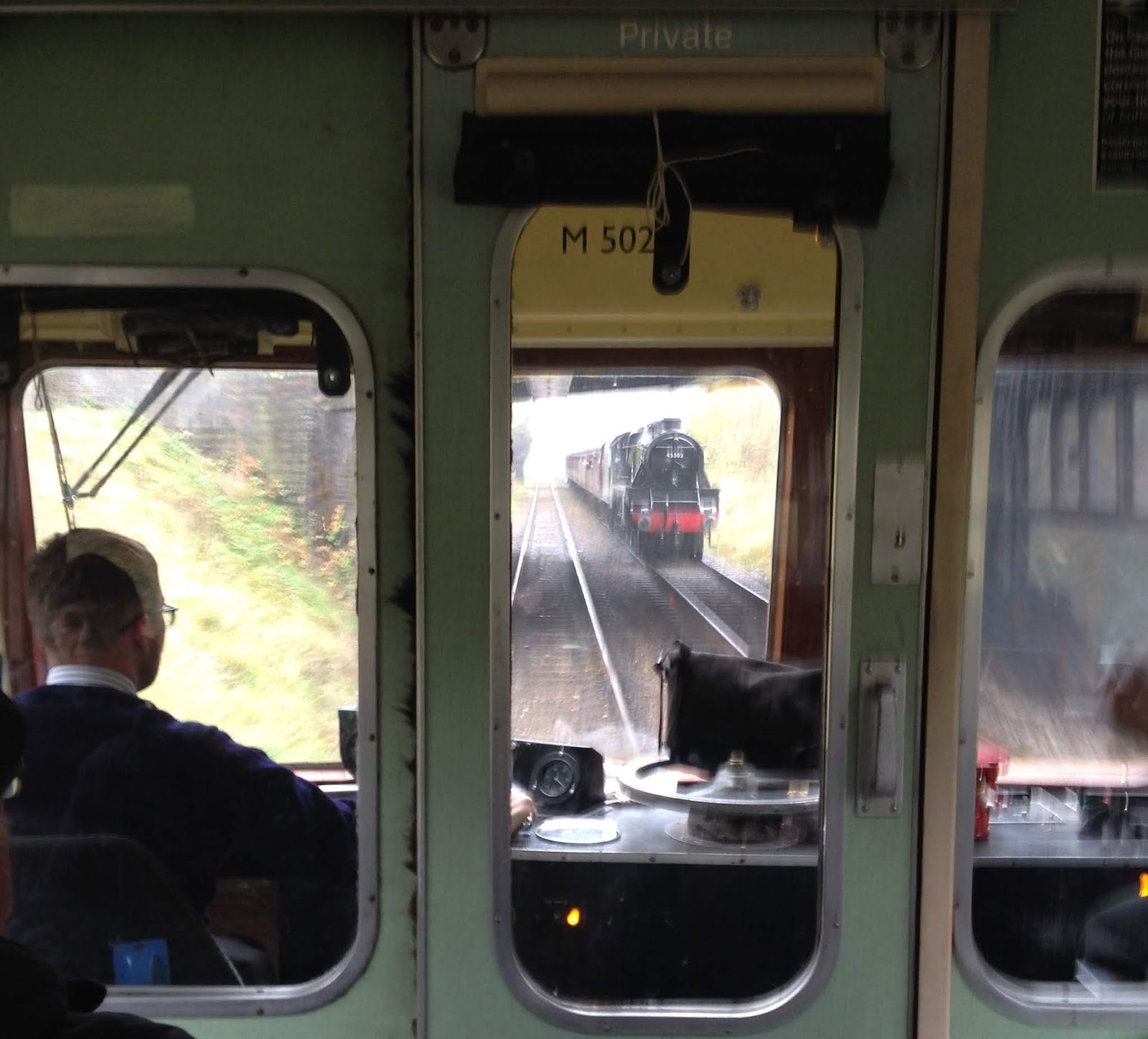
The one advantage of the “Multies” [DMUs] was that you could see the numbers on approaching steam locomotives from the comfort of your seat, instead of having to stick your head out of the window. So, it was in the sixties between Birkenhead Woodside and Chester General, as well as New Brighton to Chester Northgate and Wrexham. This reminder was at the Great Central Railway’s “Last Hurrah” of the season on Sunday.


Saturday, 9 November 2019

Seacombe station


These shots of Ivatt Class 2 2-6-2 tank No. 41231 were taken by John Dyer in October 1958. The train is destined for Wrexham Exchange. I can’t remember going to Seacombe station, but in 1957/8 I attended Poulton Junior School, where the line ran through a cutting [now occupied by the tunnel approach road] at the foot of the playground. Mum also allowed me a brief occasional detour on our way home to visit Poulton station in Mill Lane.